

We go through yogurt like most families go through bread. I make almost a gallon every week, and we just love it. It’s so packed with goodness in many ways, both gustatorily and nutritionally. (I might have made up a word there; please forgive me! I just mean it’s SO tasty, right?!)
I think yogurt is super easy to make yourself. You must try it. Check out my method for easy homemade yogurt without a yogurt maker and my Instant Pot yogurt recipe…or if you want something even easier – although I didn’t think it possible – keep reading.
I was shocked to read about Cultures for Health’s countertop yogurt cultures. You don’t have to heat the milk at all (and forget cooling it, finding a candy thermometer that works, incubating at the right temp, yadda yadda). You just stir in the correct amount of starter, which can be a bit of yogurt from your last batch, let the jar of milk sit on the counter or in a cupboard, wait 12-18 hours, and you have yogurt. That’s easier than a PBJ sandwich!
Do You Get Excited About the Mail?
I was so excited for my package of mesophilic (a fancy word for a bacteria that will grow at room-temperature) yogurt starter to be delivered! I started the cultures during lunch immediately after the package arrived. The instructions have you rehydrate a bit of dried yogurt starter to make just a half cup of yogurt, then use that to make a whole quart that you can eat. It was all I could do to restrain myself from tasting the ½ cup starter!
Once I was sure the quart of yogurt worked, I froze the second half of the starter as insurance in case I kill my starter. (For example, see what I did to my poor kefir grains!) I also have half the dehydrated starter on hand as a secondary backup.
I cannot emphasize more how easy these cultures make yogurt. 24 hours and done. Milk becomes yogurt. You do have to keep your culture going once a week to keep it active (one good reason why I have some backups!), but ultimately that should be easy to do because there’s no work involved – no stove, no pot, water, lugging the cooler up the stairs…yeah baby!
How to Make Countertop Yogurt Tutorial
(aka Room Temperature Yogurt or Mesophilic Cultured Yogurt)
Here are my supplies to rehydrate the starter and culture a half cup of yogurt, which can then be used to make the next batch.
- 1/2 cup whole milk
- starter packet (you use 1/2 tsp and reserve the other 1/2 tsp in case you kill your yogurt at some point)
- jelly jar
- coffee filter
- jar ring lid


1. Put 1/2 tsp yogurt starter in the jar.
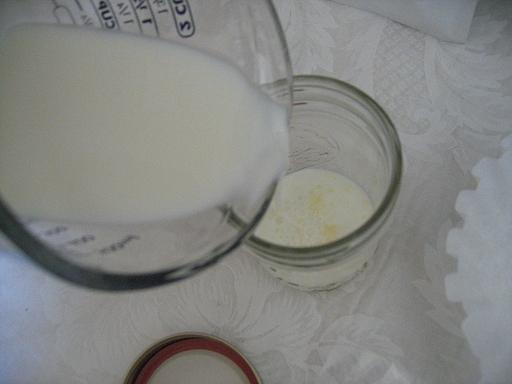

2. Pour 1/2 cup milk in.
3. Stir.
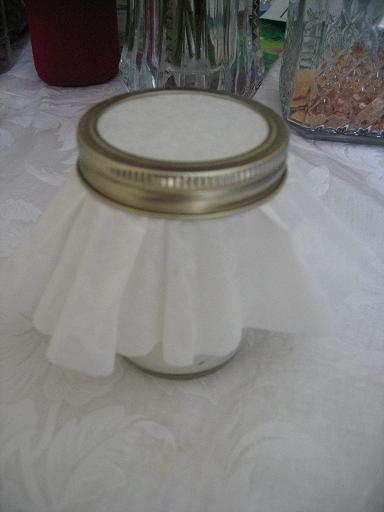
4. Put coffee filter on top (so the cultures can breathe) and secure with the ring lid (or a rubber band).
5. Set in a warm place (70-77 degrees) for 24-48 hours. Test it to see when it doesn’t run up the side of the jar anymore.
Ta da! Yogurt.
Use the yogurt to make more at a ratio of 1 Tbs per cup of milk. If your house is a little cool for the yogurt’s preference, you can incubate on top of your refrigerator, or in the cupboard over your stove where it’s a little bit warmer.
You just want to make sure the temp doesn’t drop below 70 degrees, which happens in our house, even in September.
One precaution I took was to freeze 1/4 cup of yogurt from that very first starter batch. Now I have a second back-up if when I kill my starter, or choose to let it go because we went camping. When I’m ready to make more yogurt, I’ll just thaw it on the counter and mix into a quart of milk, then save another baby food jar’s worth of yogurt insurance from that batch in the freezer.
These cultures work well with raw milk, but you do need to read the directions about making a pasteurized “seed” for your starter.
The only catch to this method of making yogurt is that you should make a new batch once a week. If you make a quart at a time, that shouldn’t be a problem! Just don’t forget to pull out your starter for the next batch right away. I like to set it aside in a baby food jar immediately so I don’t forget and eat up the whole quart of yogurt.
Ready to try homemade yogurt? There’s almost no excuse with this method! Easier than a PB and J sandwich, for real.
Order your starter from Cultures for Health and get excited when the mail comes!
Our Family’s Reviews
I chose the Viili culture from Cultures for Health. I wanted something thick and mild, and the “most popular” one sounded good to me! However, the finished product leaves a bit to be desired compared to my regular homemade yogurt with Dannon starter.
It’s very thin, but you could drip some whey out in a cheesecloth to thicken it up. My kids liked the yogurt – they’ve been trained to appreciate the tang of plain yogurt without any sweetener. It was more tangy than I could handle, but keep in mind that I didn’t even like yogurt, one bit, until four years ago. I liked it mixed half and half with my regular homemade yogurt (but if I have to do that, why make both kinds anyway?). My husband said he had to add at least twice the sugar to the yogurt to tolerate it, and still didn’t love the flavor.

The Bottom Line
If you want to have yogurt on hand for smoothies, frozen yogurt, or baking, you’ve gotta try a countertop culture. If you are ready to experiment with a new flavor of yogurt, Cultures for Health is absolutely for you. Room temp incubating couldn’t be easier.
If you are a newbie to yogurt and tend to like the sweet, flavored stuff, you might want to work yourself up to Viili (or try another culture). If I try another, I’m going for Matsoni next time. It’s still described as thick, and I think I like tart more than sour.
Wondering about kefir? Wonder no longer: Is Water Kefir as good as Soda Pop?
I am a guest lecturer and partner with GNOWFGLINS eCourses, so I will earn commission from any sales made starting here. Of course, the courses are also an awesome way to learn to cook real food, so I’d gab about them anyway.
I’m well known for honest, thorough product reviews…

…and you can always tell a real family has run these products through the gauntlet.
When I review a type of item, I try to review a LOT of different brands! From over a dozen reusable sandwich bags to over 120 natural mineral sunscreens, I’m your girl for straight-up info about natural, real foodie items you’re considering buying.
Click here to see more product reviews and you’ll also love my resources page, with REAL products that have passed my rigorous testing enough to be “regulars” in the Kimball household, plus some other comprehensive reviews. Updated at least once a year to boot the losers and add new gems!


Pingback: A Closer Look: Matsoni Yogurt Starter
I guess my question did not quite make sense, what I ment was can you use organic cultured yogurt from the store to make countertop yogurt.
Patty,
So sorry your comment went unanswered for so long! Yikes! I could have sworn I typed this answer…maybe I just thought it?
Anyway, yogurt from the store would incubate between 90-110F, so unless you live in a very warm climate, you’d need a special culture for countertop yogurt.
Katie
can you use organic yogurt from the store?
We just ordered the viili culture and I hope we like it, after reading this review of yours. I thought it said it would be thick though? It was the one my husband said he’d like, since he’s the one who eats most of the yogurt these days, though I hope I can start eating more too! The matsoni does sound yummy too, should have maybe ordered that one… We’ll see 🙂
Pingback: Festival of Frugality #196: Juggling
I mean “ease” 😉
I have also tried their yogurt starter and love the easy in which it takes to make. So very easy!
Pingback: Pennywise Platter Thursday 9/17
These cultures sound great! I need to give them a try.
.-= Kara´s last blog ..The Best Chocolate Chip Cookies. Ever. Really. =-.
Never heard of room temp yogurt. I also make a ton. Between soaking grains and Casimir, I can’t keep up. He is two and he refuses to drink milk. He drinks yogurt (if drink is the right word since it’s so thick). At times I wish he would drink milk because it’s easier, but I know the yogurt is better. Someday something in my live will be easy! 🙂
Girl, you better get in this giveaway, and I hope you win! Cas would love the Viili and probably the Matsoni too. It’s perfect for drinking, and would be SO easy for you!
🙂 Katie