
- My History with Bleach, Washing Dishes, and Chicken
- The Story that Woke Me Up to the Hazards of Bleach
- Is Bleach Even Effective?
- How Strong Does a Disinfectant Need to be to Kill Germs and Bacteria?
- The Toxicity of Bleach vs. Thymol
- Natural Alternatives to Bleach Don't Cause These Health Issues
- Why No One Uses EPA Approved Natural Alternatives to Bleach
- Thymol: Safe Alternative to Bleach that Actually Kills Germs and Bacteria
- Hydrogen Peroxide: One of the Other Natural Alternatives to Bleach
- Silver: Another Non-Toxic Alternative to Bleach
- Is Thymol the Same as Thyme Essential Oil?
- Bleach: Overused Even When Necessary?
- How to Replace Bleach in Your Cleaning and Dishwashing Routines
- Bleached Water?
- COVID-19/Novel Coronavirus Natural Disinfectants Without Bleach
- How Do YOU Disinfect with Bleach Alternatives?
- More "Clean" Posts You'll Enjoy:
Wishing there was a natural disinfectant as effective as bleach without all the hazards? Whether you’ve been washing dishes with bleach or just need to sanitize surfaces, YES, there are alternatives to bleach that are EPA-approved, even for childcare facilities to disinfect naturally. From hydrogen peroxide to kill germs to thymol to essential oils, we’ll explore the best of non-bleach disinfectants in today’s post!

Have you ever felt ill after inhaling too much bleach? Do you feel that tickle in your throat when you clean with it? Do you wonder if it’s actually safe to clean with bleach, or wish there was a natural alternative?
Bleach kills germs and mildew, whitens fabric and is a great all-around, frugal cleaner, right?
But imagine if you could get your countertops just as clean and disinfected with a natural product that wouldn’t make your nose burn.
My History with Bleach, Washing Dishes, and Chicken
I still remember when my mom discovered how easy it was to disinfect with bleach water (that was years ago, and before I knew about natural alternatives to bleach or that bleach was bad for me).
We both felt like we had trumped the system, avoided toxic, costly sprays and knocked the salmonella right off the raw-chicken-covered cutting board. Current wisdom at the time said only a quarter cup per gallon water was needed to totally disinfect after cutting raw meat, so we both had our spray bottles under the sink, ready to go.
I also remember working one summer in a daycare facility, and every day I had to wash the snack dishes in hot soapy water, rinse them, then give them a dunk in a tub of bleach water and allow them to air dry, per state regulations (way before I knew about natural disinfectants approved for childcare facilities). I’m fairly sure I used a “glug” of bleach in the washtub, however much that was from day to day.
I thought that federal or state childcare regulations, which are very strict, mandated only bleach water and air drying as an appropriate way to disinfect surfaces, but it turns out that the CDC allows any EPA-registered disinfectant to be used (a welcome surprise!).
RELATED: How to Clean Baby Toys.
The Story that Woke Me Up to the Hazards of Bleach
I read a story a few years ago about a boy doing his homework in his room. He was concentrating and writing a delightful essay about such-and-such and so-and-so (can you tell I can’t find the exact source for this story?), when rather suddenly he began to feel less focused and his handwriting actually changed and became sloppy, as did his line of thinking.
The only thing that changed in his environment was that his mother was using bleach in the laundry room below, connected to his room by the ventilation system. Inhaling bleach fumes actually decreased his concentration, motor control, and cognition. As a teacher, I was shocked by the handwriting sample and even more shocked to think about how much bleach was used in my old school building.
Did you know that housewives have some of the highest rates of air-pollution-caused disease?1 The indoor air quality in many homes is some of the most hazardous around, in part (in most part?) because of fumes from cleaning products.2
Cleaning supplies are the one place you can afford—and even save money on—non-toxic options!!
Have your cake and eat it too with these simple tips from a mom with 20 years in the trenches of keeping her family safe (and mostly clean).
I created this when a young woman in need asked for bathroom cleaning supplies as a Christmas gift. 💔 My teacher heart wanted to teach her to fish, not just give her a fish.
Download it now in both a pretty version to look at and a black-and-white version to print:
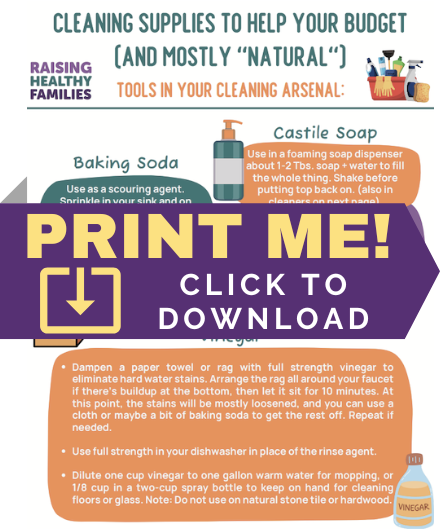
As a guest of Kitchen Stewardship, we’re pleased to give you this PDF. No need to trade your email address! We got you!
Is Bleach Even Effective?
It’s used extensively, but is bleach even doing what all these inhaling housewives expect?
First of all, bleach has to dry on the surface you’re trying to disinfect in order to kill all the bacteria. That may make you think twice about adding a glug of bleach to your dishwashing water. Besides that, some dish soaps have ammonia in them – major death-wish no-no!
Secondly, bleach becomes ineffective when it touches organic matter, which means that any food or gunk on whatever you’re trying to disinfect must be completely cleaned off first, before spraying a bleach solution on.3
All we really want is a product that will kill germs, you know “disinfect” or “sanitize” our surfaces to keep our families safe! But…do we even know what those terms mean?
How Strong Does a Disinfectant Need to be to Kill Germs and Bacteria?
The CDC’s three levels of disinfection used to rank are as follows:
- High-level disinfection – kills all organisms, except high levels of bacterial spores, and is effected with a chemical germicide cleared for marketing as a sterilant by FDA. Typically not used for generalized disinfecting. In other words, I’m reading this to mean not for household use.
- Intermediate-level disinfection – kills mycobacterium, most viruses, and bacteria with a chemical germicide registered as a “tuberculocide” by EPA.
- Low-level disinfection – kills some viruses and bacteria with a chemical germicide registered as a hospital disinfectant by the EPA.
The Toxicity of Bleach vs. Thymol
In a document titled “EPA Registered Hard Surface Disinfectants Comparison Chart”4 you can see a comparison of six “active ingredients in institutional disinfectant products” including chlorine bleach and Thymol, the “botanicals” example found in Benefect and other natural sanitizers, including Cleanwell.

Of the six active ingredients found in institutional disinfectant products, only Thymol and bleach are “intermediate level disinfectants,” with the other four coming in at “low level disinfectant” or a combination of the two depending on formulation. Benefect is also on the list of registered antimicrobial products for avian (bird) flu disinfectants and also approved against SARS-COV-2 aka COVID-19, both the disinfectant spray and wipes.
Bleach and the natural disinfectant made from thyme quickly diverge on the next line, however, when the EPA rates the compounds’ “toxicity category.”
Chlorine bleach and the phenols are rated as a “category I,” described as “highly toxic” and lethal at levels ranging from a few drops to a teaspoonful orally. They are marked by law with a skull and crossbones and the words “DANGER. POISON.” Nice.
“Quaternary Ammonium Compounds” and “Accelerated Hydrogen Peroxide (hydrogen peroxide/anionic surfactants)” are both category III, “slightly toxic.” Lethal levels are over one ounce to one pint.
Do you still feel just as safe having bleach in your house?

Natural Alternatives to Bleach Don’t Cause These Health Issues
Here is a short list of issues chlorine bleach has been linked to:5
- Respiratory issues
- Skin burns
- Damage to nervous system
- Exacerbates Asthma
- Headaches
- Vomiting
- Accidents that cause the skin to come into direct contact with bleach or people ingesting it (as many as 700 adults per year)
- Linked to cancer6
Just to make sure you don’t miss anything, the EPA also lists “health effects” of bleach, including:
- Mixing with ammonia, ammonium quaternary compounds and other acidic products can create poisonous gas.
- Corrosive to eyes and skin, and a respiratory irritant.
- Suspected cardiovascular, gastrointestinal or liver, kidney, central nervous system, respiratory, and skin or sense organ toxicant.
It’s also “Toxic to aquatic organisms” and should be used only with “increased ventilation.”
How many windows are open in most schools, bathrooms, etc. when bleach is used?
Many sources say that chlorine by itself is not hazardous and will break down before it reaches the environment, which may be true (but it sounds a little too good to be true).7
One real hazard of bleach is that it can’t be mixed with ammonia, vinegar or other acids, and even organic matter (and what would you normally clean up with bleach? Organic matter, of course.). Each of these compounds causes a reaction with bleach that emits toxic, potentially carcinogenic fumes.
And this is stuff that’s added to city water across the nation and poured into school buildings and other public places.
Now I know – the germs bleach is killing, the mold, the bacteria – all can cause massive health problems too.
But what if there was an equally effective disinfectant that didn’t come with so much baggage? A non-bleach disinfectant?
The EPA says there are a few. Is anyone listening?
Why No One Uses EPA Approved Natural Alternatives to Bleach
In reality, though, I think people go with what they know – when I offered to bring a bottle of natural spray with essential oils for my daughter’s preschool class one year, the teachers were interested in natural alternatives to bleach, but their superiors said no, that they had to use the approved “3-step method” to clean and disinfect (this is not for dishes, just desks and surfaces in the classroom).
They were requesting Clorox’s “Anywhere” spray, which has 3 great ingredients and one, sodium hypochlorite, that decomposes into chlorine and is itself “an essential ingredient in bleach” according to Clorox’s website.
Sounds like a “same old product, new packaging and marketing” situation to me.
Similarly, our librarian also always assures us moms at Babytime that all the toys are sprayed down with a bleach solution. (squirm, squirm)
Even though the bleach should be completely evaporated by the time my 19-month-old is gnawing on the toy car wheels, I still think there’s a better, safer, perhaps even MORE effective way!
It’s time to get the word out there —
Thymol: Safe Alternative to Bleach that Actually Kills Germs and Bacteria

Thymol, which you’ll remember is equal to bleach as an “intermediate level disinfectant,” along with “Silver Dihydrogen Citrate (example –PureGreen 24)” are the only category IV substances on the EPA’s chart, the safest available, lethal only in levels over one pint (that’s two cups) up to a pound orally. They’re officially titled “relatively non-toxic.”
In my mind, bleach is already out to the curb, but just to prove that Thymol is just as effective, here are the “bugs” they’re each rated to be effective against:
- Bleach: “Effective against most bacteria and some viruses and is registered as effective against HIV, HBV, H1N1 (Influenza A), MRSA and TB.”
- Thymol: “Effective against a broad spectrum of microbes including H1N1 (Influenza A). TB and MRSA.”
That’s good enough for me!
And it’s truly safe: “The EPA is not aware of any adverse effects of thymol to humans or the environment when it is used in a manner prescribed by product labeling. The Agency has no significant incident reports involving thymol.”
Both are supposed to “dwell,” or sit on the surface, for 5-10 minutes, but for bleach, “rinsing is required in applications where direct skin or oral contact can occur (children’s toys).”
Considering all those “sprayed down” toys in nurseries across the nation, I’m thinking most providers aren’t reading that far down. I used to spray down all the secondhand baby toys I bought with bleach water and let it sit because I knew about the “dwell time” and air dried everything.
Hydrogen Peroxide: One of the Other Natural Alternatives to Bleach

You may not have Thymol on hand (yet). Until then, consider commercially available 3% hydrogen peroxide, a stable and effective disinfectant when used on inanimate surfaces,” according to the good old CDC.
I mix it 50/50 with water to avoid ruining my clothes and use that as a general spray in the kitchen. Paired with vinegar in separate bottles, research shows it to be even more highly effective at killing bacteria.
Raise Them Well, a company begun by a physician and his wife, has a great Kid-Safe sanitizer. The active ingredient is stabilized oxygen, which is along the same lines as hydrogen peroxide, especially as far as safety.
They’re even certified by the Toxic-free Foundation! The sanitizer either foams or sprays depending on the size of bottle you buy – we love it here, and there’s no scent at all if you have a sensitive olfactory family member.
This formula is less strong than hard surface cleaners, however, a few of which are EPA-registered, such as OxyCide (peroxide and peracetic acid) and Peroxide Multi Surface Cleaner and Disinfectant.
Silver: Another Non-Toxic Alternative to Bleach
I went through some EPA “registered disinfectant” documents (you’re welcome, those of you who aren’t bored to tears right now) and began to look up any product that sounded remotely natural or like it might not use bleach.
Unfortunately it wasn’t always easy to find ingredients (never a good sign) but I did come up with another active ingredient that may be a good alternative to bleach when it comes to antimicrobial action. Brands actually have to get their product registered with the EPA, and Pure Hard Surface is one example.
Its active ingredients are silver (0.003%) and citric acid (4.846%), and it’s approved against bacteria, viruses, and fungi including MRSA, human coronavirus, norovirus, listeria, E. coli, and salmonella – all on food contact surfaces without a rinse. Impressive!
Does this mean that any product that uses at least that concentration of silver will have such an antimicrobial germ-killing effect? No. That’s why the EPA requires each product registered individually.
But I feel pretty safe extrapolating for my own family that a product like 3rd Rock Nutrasporin (100 ppm silver, less percentage than above but for use on skin) and their other silver products will be helpful in preventing germs. Use the code KITCHENSTEW for 20% off.
Is Thymol the Same as Thyme Essential Oil?
In my opinion, you can use any thyme essential oil (and there are other essential oils that are anti-bacterial and anti-viral, too, they’re just not patented and registered). Thymol is the active compound in thyme oils, but it’s technically not exactly the same, tested and proven.
Remember that this isn’t “official” advice, although more research is being done all the time on EOs.
Do you know how to properly dilute essential oils?

Katie here, popping in to tell you how important it is to be sure you’re diluting those essential oils properly.
Sure, you know not to use EOs straight (neat). But do you know the 1-2-3 math so it’s not too strong or weak?
Print this chart to keep with your oils so you never have to do math in the middle of the night when your LO is congested:
As a guest of Kitchen Stewardship, we’re pleased to give you this PDF we created years ago. No need to trade your email address! We got you! Note that this may include some outdated content but should still be super helpful.
You can read more about why it’s so important to dilute essential oils here, and I know the little chart will be helpful!
DIY Thyme Disinfecting Spray
Ingredients:
- 10-30 drops thyme essential oil
- 1 oz. rubbing alcohol
- 8-oz. spray bottle
Put thyme essential oil into an ounce of rubbing alcohol, shake it together, then fill the rest of an 8-ounce spray bottle with water.
- Benefect hand sanitizer at Amazon.
- Cleanwell products at Amazon, also available at Whole Foods, Target and other brick-and-mortar and online stores.
- Seventh Generation Disinfecting Multi-Surface Cleaner, at Amazon (also sold as individual wipes like our school often requests on supply lists) or Grove Collaborative.
- Note: Not all 7th Gen cleaners use thymol, and some use a methylisothiazolinone sodium benzoate preservative that is “natural” but still not great, so read the ingredients closely.
Bleach: Overused Even When Necessary?
Ironically, when my mom and I used to use about 1/4 cup bleach per gallon water, we would lament about all the people who used much more and didn’t need to. Turns out that we were probably overdoing it too. That ratio is only for potty messes in daycare. 1 Tbs./gallon is for non-mouth objects. Dishes and counters, like we were cleaning, should have only 1 teaspoon per gallon water!
It’s also recommended in these child care facility guidelines that bleach water does not go in a spray bottle so it’s not “aerosolized.”
Oops.
And.
You’re supposed to mix up new bleach water daily. The EPA document I walked you through above states, “When mixed with water the solution is only effective as a disinfectant for 24 hours.” You also have to get rid of your bleach after 3 months. Why? Because it degrades so fast that it’s no longer effective for disinfecting after that time (although it will still bleach clothing). So much for having bleach “on hand for an emergency.” Do you replace your jug at least twice a year? And then what – toss the rest?
In contrast, essential oils (such as the one the EPA-registered Thymol is based on) last for years and are great for both preparedness and everyday applications. They’re not without any hazards and can sometimes burn (superficially) if certain ones are used without a carrier, but the list of deficits is far, far shorter than that for chlorine bleach.
How to Replace Bleach in Your Cleaning and Dishwashing Routines

Here are some of the most common places you’ll find bleach in the kitchen:
- To disinfect the counters/dishes after cutting raw meat
- In dishwasher detergent
- In dish soap
- Some add bleach to their dishwater
So now you need to know what to do instead of bleach, right?
- To wash dishes: You simply don’t need bleach. Just use dish soap. If you feel the need to disinfect your dishes, either use the sanitizing cycle on your dishwasher, pour boiling water on them, or spray after washing with one of the other options in this post.
- Dishwasher detergents: This is a sticking point for me. There are good natural commercial detergents out there that don’t use bleach. Because the dishwasher sends out steam that would otherwise be laden with bleach fumes (and heating it makes it easier for your body to absorb, unfortunately), dishwasher detergents are a really important area to “go green”.
- Don’t buy products “with added bleach.” Yuck! Just wash stuff.
- To sanitize after cutting raw meat, especially chicken? Use the hydrogen peroxide/vinegar combo I explain here, in separate bottles.
Bleached Water?

The chlorine added to city water is another thorny issue. Certainly we need access to clean water, and we are so blessed here in America to avoid the diseases that are so rampant in countries with tenuous or unsafe water supplies.
On the other hand, I’ve seen “chlorinated water” quite often lately on lists of “things that cause health problems,” such as candida, gut imbalances, and more.
I don’t know – but without doing exhaustive combing of medical journals, I can say with certainty one thing. There is no denying that the chlorine in city water has an impact on human health.
For example, when making water kefir, one cannot use city water without taking steps to get the chlorine out, or the yeast and bacteria that ferment the beverage will die. Also, my King Arthur Flour Whole Grain Baking book talks about baking bread with city water, and they insist that you must leave a bowl of water out overnight, because the chlorinated water harms the yeast, and the bread won’t rise as nicely.
And those people are a for-profit business, not the “natural, crunchy” community.
I ask you, as a thinking person: isn’t it logical to assume that if chlorinated water hurts the healthy yeast and bacteria in bread baking, it would also have some destructive effects on the healthy bacteria in our own bodies?
For our family, I am happy to remove the chlorine from our city water with our Berkey filter, along with fluoride and a host of other contaminants, while leaving the minerals intact.
COVID-19/Novel Coronavirus Natural Disinfectants Without Bleach
The bottom line, if you’re wanting to sanitize or disinfect your home to protect your family from viruses in general, is that YES—there are safer, more natural alternatives to bleach, including the following active ingredients in EPA-approved products specifically for use against SARS-CoV-2 (more are being added every day):
- Thymol (active ingredient in Benefect and others)
- Hydrogen peroxide
- Silver
The CDC recommends routine cleaning and disinfecting, and if someone in the home IS ill, pay special daily attention to high-touch surfaces like door handles and light switches, phones, remote controls, toilets, sinks, etc.
Note that these are all for hard surfaces, NOT for human skin (aka not sanitizers!). Check out the dangers of conventional hand sanitizer and the best natural hand sanitizers.
How Do YOU Disinfect with Bleach Alternatives?
As good kitchen stewards, we must start with the question – once you’ve cleaned off the visible gunk, how do you attack the invisible germs and other buggers? (and do we need to??)
In schools, they have to – so how do we play along and keep our kids’ airways and brains safe?
After reading that the EPA rates natural disinfectants based on thyme oil, hydrogen peroxide and silver as effective as bleach, I hope you consider finding some natural alternatives to bleach and then banish bleach from your home once and for all.
If you have children in daycare, which includes ANY preschool, consider having a conversation about EPA-registered disinfectants and how the providers might use natural alternatives to bleach. This EPA document titled “Green Cleaning, Sanitizing, and Disinfecting: A Curriculum for Early Care and Education” completely gives me hope that eco-friendly health and safety will go mainstream someday. It covers the good side of germs, harmful health effects of chemicals such as endocrine disruption and inhalation dangers, risks of triclosan, fragrances, parabens, and improper ventilation, and why children are more susceptible to environmental impact than adults.
It’s a bit long though, so feel free to use this post to know exactly what to say when someone recommends using bleach to disinfect!

More “Clean” Posts You’ll Enjoy:
- On handwashing and antibacterial soap
- Are waterless hand sanitizers okay? On creating “superbugs” with triclosan
- Too Clean Can be a Bad Thing
Sources:
- “Did you know that housewives have some of the highest rates of air-pollution-caused disease?” 1 Pinkerton, K. E., Harbaugh, M., Han, M. K., Saux, C. J. L., Winkle, L. S. V., Martin, W. J., … George, M. (2015). Women and Lung Disease. Sex Differences and Global Health Disparities. American Journal of Respiratory and Critical Care Medicine, 192(1), 11–16. doi: 10.1164/rccm.201409-1740pp. https://www.ncbi.nlm.nih.gov/pmc/articles/PMC4511423/
- The Inside Story: A Guide to Indoor Air Quality. (2019, October 3). https://www.epa.gov/indoor-air-quality-iaq/inside-story-guide-indoor-air-quality
- Normand, J. (Ed.). (1995). 6 The Effectiveness of Bleach as a Disinfectant of Injection Drug Equipment. In National Research Council (US) and Institute of Medicine (US) Panel on Needle Exchange and Bleach Distribution Programs. Washington, DC: National Academies Press (US). https://www.ncbi.nlm.nih.gov/books/NBK232358/
- List C: EPA’s Registered Antimicrobial Products Effective Against Human HIV-1 Virus. (2020, March 4). https://www.epa.gov/pesticide-registration/list-c-epas-registered-antimicrobial-products-effective-against-human-hiv-1
- https://emergency.cdc.gov/agent/chlorine/basics/facts.asp
- Morris, R. D. (1995). Drinking water and cancer. Environmental Health Perspectives, 103(suppl 8), 225–231. doi: 10.1289/ehp.95103s8225. https://www.ncbi.nlm.nih.gov/pmc/articles/PMC1518976/
- Toxic Substances Portal – Chlorine. (2010, November). https://www.atsdr.cdc.gov/phs/phs.asp?id=683&tid=36
Are you still using this product? I was just doing research and found your post and another one talking about how bad thymol is so now I am just confused!
http://www.girlmeetsgeek.com/2013/05/25/seventh-generation-when-natural-smells-awful/
I have taught our children to clean with the separate hydrogen peroxide/vinegar spray bottles. The bad thing is that it has corroded our faucet fixture! Now it is ugly and embarrassing. I don’t want to replace it if the new one is going to corrode also. It used to be a gold color, but now more like a spotted dull gold/bronze when newly cleaned, and green when left for a few days.
Oh no Elizabeth! I think for bathrooms I would just use the peroxide and water 50/50 mix – should be enough plus wiping to be clean for faucets. 🙂 Katie
Would this be enough for whitening a bathtub?? I really don’t want to use any toxic substances but this bathtub needs something strong. Any suggestions?
Hi Mei! I’ve seen hydrogen peroxide and baking soda mixed for cleaning bathtubs and removing stains! You can find specific ratios and directions online.
Katie,
I’m sorry, I got so wrapped up in the response to Tim Williams’ comment that I totally forgot to thank you for such an informative, well thought out and written post. I do a lot of research on the chemicals that we’ve been trained to use (by advertisers) in house cleaning and all of the health effects associated with said chemicals. I also spend a lot of time reading about natural options. I’d be willing to bet that in a few years, you’ll be seeing a lot more products on the shelves with natural essential oils like thyme, parsley seed, tea tree, eucalyptus and the like.
I thoroughly enjoyed my visit and I look forward to coming back!
I LOVE this thread, I’m in the UK and do not use bleach or other harsh chemicals. I’m setting up a business as a therapist offering chemical free beauty treatments, I was searching to find a natural alternative to the stuff we have to use to disinfect tools like cuticle nippers, so thanks. I’m going to find you on facebook!
I found this conversation when looking for alternatives to bleach for “shocking” a private well. Does anyone have any suggestions for products that are effective alternatives?
Thanks!
This was well-written, thorough, and reminded me why I follow you on Facebook, 🙂
Thymol safer than bleach? You’re kidding me, right? (or maybe you’re just really ignorant of the facts).
Thymol is a carcinogenic liver toxin. Under NO CIRCUMSTANCES should you regulary use thyme oil or thymol (a component of thyme oil) for any purpose. Its safe use must be limited to the small, infrequent amounts used in cooking.The National Institute of Health says: “BELIEVED TO LIE NEAR BORDERLINE BETWEEN TOXICITY CLASSES 3 AND 4 (MODERATELY TO VERY TOXIC).”
check that reference on ToxNet: http://toxnet.nlm.nih.gov/cgi-bin/sis/search/a?dbs+hsdb:@term+@DOCNO+866
Bleach, on the other hand, is used everywhere from hospitals to industry BECAUSE IT IS SAFE. It degrades readily and speedily to form salt and water. In fact, it degrades SO readily that the shelf life of unopened bleach is just six months!
The degradation reaction is quite simple. The chemical formula for bleach (sodium hypochlorite) is 2NaOCl. It is not comfortable in this state (it’s unstable) and desperately “wants” another oxygen atom. It rips this oxygen off of anything handy – pigments and dyes are handy sources, as are things like bacteria and cell walls. This is what kills bacteria – just the removal of a single oxygen atom! There’s nothing toxic about that.
Then, having obtained its needed oxygen atom, the bleach happily degrades into oxygen and table salt. 2NaOCl –> O2 + 2NaCl .
So I’m sorry but you are so, so, SO very wrong it’s stunning. Try checking some basic facts next time instead of cherry-picking phrases out of context…
Tim,
Although your tone wasn’t very kind, you seem to know a lot and I’ve begun looking into the notes you shared. I assure you, I’m not out to trick people into using toxic chemicals, so if I’m in error, it’s 100% the result of lack of knowledge (also called ignorance).
I need to carve out some time to understand whatever facts I’m missing here, and when I do get through the dozen tabs I now have open, I’ll be sure to update this post if necessary. Thanks for pointing me in a new direction — Katie
Did you update somewhere regarding Tim Williams’ comments about Thymol? What did you learn from those dozen open tabs??
Regarding his claim that bleach is safe, my lungs and eyes say hooey. Anytime my daughter used it to clean our bathroom, it made my eyes sting and my lungs feel distressed. And that was just from the air that wafted out into the rest of the house.
We don’t use bleach anymore at all. I clean with water, vinegar, and/or baking soda. And I hardly ever get sick, even though my daughter (who lives with me) routinely gets sick working at a daycare that uses bleach all the time!
Thanks for this post, and for any reply to my question!
I say hooey too! 😉 You know, I still have that post from all that research on my to-post list – I almost posted it last week but took a different theme for the week. HOpefully it’s coming soon!
🙂 Katie
Toxicity between “classes 3 and 4??” Tim’s link for his statement lead me to “Lethane 384” which is listed as a chemical compound, not thymol! The whole Thyme oil is what I use. Thymol is also in some other essential oils that prove very helpful in studies. Here’s just one study where thyme and oregano have helpful effects on mouse digestion! http://www.ncbi.nlm.nih.gov/pmc/articles/PMC2233768/. I used hand sanitozer with thymol in the past, though now I just make my own from essential oils (cheaper!) or use a hand sanitizer with cinnamon and other oils (“Thieves”). It sounds like KitchenStewardship was pointing us in the right direction – thank you, Katie! Please keep up your good work.
Tim,
You are correct to a degree. The unfortunate fact is that Sodium Hypochlorite (bleach) SLOWLY decomposes to table salt (NaCl), oxygen (O2) and H2O. The first stage of decomposition however, is to release sodium ions (Na+), chlorine ions (Cl-) and hydroxyl radicals (OH-). This is why you smell the chlorine when you use bleach. It is released in its natural form, as a gas. Eventually, bleach will continue to decompose to salt, oxygen and water when left long enough.
Another mistake in your comment earlier is that Thymol, is actually very safe when used to disinfect hard surfaces. In fact, a product I use to clean based on thymol was the ONLY natural disinfectant registered by the EPA as safe to leave on surfaces. Health problems only arise when it is used as a mouthwash for long term use.
I stopped using city water in my bread years ago, when I noticed it would kill my starter after two or three additions of water to the starter. I never thought about what it was doing to my guts. I drink water all day.
Another surprising fact – the chlorine in pool water is usually less than in tap water, because of the speed at which chlorine degrades.
I never gave the chlorine in tap water much thought either. However, due to things I’ve read about waste water treatment NOT being able to remove/completely remove certain chemicals and prescription drugs from water, I decided to start drinking distilled water a few years ago. The taste is so much better. Tap water tastes absolutely horrible in comparison whenever I have no other option and need a drink.
If you are drinking distilled water only, you MUST add back in the minerals that are removed! Otherwise you run the risk of becoming mineral deficient which could actually cause death if it becomes too bad.. Please research drinking distilled water long term and begin adding minerals back into your water. Also, you CAN remove those toxins by filtering your water. I have a ProOne filter and use it all the time. This is a gravity system and uses no electricity.
Seventh Generation makes a cleaner with Thymol as the disinfecting ingredient.
Hi. Yes, I’ve just purchased 7th Generation Disinfecting Multi-Surface Cleaner. Spray bottle. Thymol. Other essential oils. Lemongrass. Citronella. Also; Copper sulfate pentahydrate… Bluestone. Other goodies ingredients. Anywho… I LOVE THIS PRODUCT! Does what it says. Cleans beyond expectation. Pleasant fragrance. My new fave disinfectant spray. (Hate Clorox because it’s suffocating, literally, and burns eyes & more). The only use I might still have for Clorox, is to douse the personal city trash dumpsters, & hose out. Otherwise, no use anymore because it’s too scary. Love natural!!!
Hi,
I was wondering where is the best place to buy thymol and 3% hydrogen peroxide? I am in need of these fast.
Thanks
Emily,
3% hydrogen peroxide is what you find at any pharmacy. Thymol, probably Amazon? 🙂 Katie
I use clothe diapers and for the poo-poo ones I dip them in the toilet using my rubber gloves to pre-clean them before going into the wash, well when cleaning the gloves I have been using bleach, but would love to use something more natural, will Thymol work for disinfecting the gloves?
Keri,
I can’t say for sure – but I would do it, especially since the gloves are just going to go back to the poop, right? 😉 Hydrogen peroxide might be another option. 🙂 Katie
Loved your article…pinned to my homemaking board to keep that pdf you referenced on hand to show my hubby (a chef who only believes in bleach) as we continually have this argument about bleach versus EO’s in dishwater since our kids do the dishes as chores and we want the extra layer of protection since they are still working on their “thoroughness” skills.
My hubby just informed me recently about bleach not being mixed with soap as it makes it void of disinfectant properties so, while up nursing in the wee hours of the morning, I decided to google and stumbled upon your post.
I also found this from Stanford and thought it might be of value of you to site as well.
http://www.stanford.edu/group/narratives/classes/08-09/CEE215/Projects/greendorm/water/GraywaterCD/graywater08/sdarticle-6.pdf
Researches use and effectiveness of EO’s in treating gray water in order to reuse as an alternative to our current water disinfectant treatments.
Thanks for actually doing the research in this post instead of blindly instilling fear or trust as many natural bloggers do. Keep up the good work!
I’m researching safer sanitizers and disinfectants to use in our childcare center. But we haven’t found any safer products to rinse hand-washed dishes. Do you know of anything safer than bleach to dip dishes in?
Janelle,
I think Benefect is one good option, and hydrogen peroxide mixed in water might be another – the trick is following the federal guidelines, which I’m really not sure about. Good luck!! 🙂 Katie
When I did my girl scout camp training, they teach a 3-step method for cleaning mess kits. Soaping up the plates, rinsing in clean water and then disinfecting by dunking/air drying in bleach water. One of my co-leaders suggested we look into essential oils for the disinfecting. I’m not familiar with their use but can we add some amount of thyme drops to the last water bin instead of bleach? And if we do, is it okay to leave that to air dry and then eat off the next meal?
Rebecca,
Exactly – you should be able to make “sanitizing solutions” from thyme oil, but I’m not sure exactly the ratio. The Benefect brand that you can buy can be diluted, so that might be something to check into. Totally safe to air dry and eat of of. (but I’m not the FDA, remember that…) Good questions!! 🙂 Katie
Chlorine is effective in getting rid of germs but it can be toxic as well. We may avoid using chlorine but we all know it is utilized as a treatment for our water supply, so how are we going to deal with that?
First, drink spring or distilled water. I prefer distilled water because I think it is cleaner. For bathing, I’ve seen devices (can’t remember where) that you can attach to your shower head that supposedly remove the chlorine from water. A quick search using your favored search engine should turn up something.
Distilled water removes important minerals that are needed for the body to survive. If you drink only distilled water, you MUST replace those minerals or you can become VERY ill. Please research drinking distilled water long term and act by replacing those important minerals ASAP!
We have a whole house water treatment like RainSoft. Does Berkley treat water in your whole house? The only reason we have bleach in our home is for bleaching toilets. I have managed to find other natural alternative for everything else, but there doesn’t seem to be anything quite as good for bleaching toilets. Has anyone found a bleach alternative to bleaching toilets?
Jennifer,
No, a Berkey is a standalone filter for drinking/cooking water only. It takes no power, so it’s nice for preparedness, but not a whole house thing. I use straight vinegar in a spray bottle for toilets and do a quick squirt/scrub every 3-4 days or so, I imagine. Sometimes hydrogen peroxide on the outside. 🙂 Katie
However there ARE systems that filter whole house water. Do a search for whole house water filters to find some.
So, if I add some Thyme EO to my regular vinegar/soap/EO spray would that be a good option??
Probably? Hope so? 😉 Katie
Could you give a reference for bleach not being effective after 3 months? I don’t think that is accurate. You don’t know how long the bleach has sat somewhere before you even get it home. If this had evidence behind it, it would seem the agencies regulating daycares and similar situations would be all over it and bleach would have an expiration date?
You bet – there are two places referenced in this article already:
this one http://bit.ly/14WshtM says throw away any opened bleach after 30 days (it’s for childcare facilities) and this one http://www.education.nh.gov/instruction/school_health/documents/disinfectants.pdf is the document I was mostly walking through during this entire article. Clearly says 3 months for disinfecting purposes. I’ve also seen that many, many other places. Many preparedness resources give it 6 months. Daycares are totally regulated and have to switch out their bleach very regularly.
🙂 Katie
Are Clorox wipes acceptable according to regulations? I do not like bleach and prefer the wipes to spraying. Thank you for your very informative blog.
Debra,
I think each state sets its own regs for daycares and such…so it’s hard to say. What active ingredient is in the wipes if not bleach? I make my own wipes with vinegar and/or essential oils, and they’re great. 🙂 Katie
It always takes me a few days to read your posts, because I like to do it during quiet time. 🙂 So, I hate bleach. I always have. Even before I went “natural.”
I clean everything with white vinegar…even Annie says “Mama, are you gonna clean that with vinegar?” 😉
Kitchen Stewardship – You are right they kill what’s in the cloth but the point is they pick up everything off the surface and trap it in the cloth. It cleans mechanically first by picking it up and trapping it in the cloth.
Thanks for the tips. I have tried Bon Ami cleanser and it does nothing for my sink! I have tried many natural cleansers and unfortunately, nothing works like Softscrub with bleach! I will try the OxiClean though.
For my white kitchen sink I use a scrubber with some natural lemon glass-top stove cleaner.. I think it’s called creams-bright or something similar. It helps a lot, and I also use mr clean magic erasers for toughies!
Meleanie Schafer I would start with baking soda, then try oxygen bleach. Both fairly inexpensive and natural! Bon Ami isn’t too bad either.
Heather Aasman I have a few Norwex cloths, too, but they only kill the germs inside the cloth, not on the surface. You can clean with them, but not sanitize/disinfect.
Lea Martinez I would say at least only use a tsp. bleach to a gallon water if you have and don’t spray it while the kids are there. The thymol stuff is just “registered” because it’s a manufactured product, but that doesn’t mean that nothing else works, just that others don’t have money behind to “register.” Does that make sense? So a lot of essential oil blends likely do really, really well…
You mention your Berkey water filter. I am building a house that will have well water. What water filtration system do you recommend for the whole house and for drinking. We used to use RO, but it removes minerals. There are 8 of us, so which Berkey size would be the best?
Lori,
If I had well water, I’d have a lot less to worry about! 😉 You should probably just start with getting your water tested to see if there are things you need to filter out.
You’re right about the RO and the minerals, and the Berkey does not have that problem. If you decide there are things to filter out of your well water, Jeff at LPC Survival is really helpful about figuring out size for your needs: http://directive21.com/ You’ll probably want a big one! 😉
I doubt you’d need a whole house filter – again, when folks filter their shower and bath water, it’s mainly to get the chlorine out, which is not an issue with well water.
Good luck making the decision! 🙂 Katie
Thanks Katie!
We’ve lived in several homes that had wells, and I believe chlorine was added before it came into the house. Otherwise, it could still house harmful bacteria in the pipes or something…at least, that’s what I remember from my childhood and teen years. Maybe it’s different now in the 21st century? 🙂
You are correct Julieanne. Also, when you use the bleach (which is around, for me, 1 gallon in a 50 gallon tub which is again diluted and pumped into the water supply outside the house) you not only cut your risk of illness like Giarda from the water (which is ridiculously unpleasant) but I don’t get rust stains. If I forget and let it run out, my toilets, showers, and laundry turn orange, and then I’m circling to use harsher chemicals to get rid of the stains. The natural stuff just doesn’t cut it on the heavy rust stains.
We have well water and don’t need to add bleach unless we are planning to store water for long-term usage. We get our well water tested regularly and it always comes out perfectly clear. You have to have a really shallow well to have issues with Giarda leaching in. Our toilet gets an orange tint on it but I’d rather clean the toilet than ad bleach to perfect well water that tests germ-free every time.
I assumed that wiping and scrubbing with soap and water and then rinsing with water was getting rid of the invisible stuff too. am i wrong?
Rebecca,
Soap and water and a good scrub is PERFECT for regular cleaning. I usually rely on elbow grease, maybe a little vinegar water, myself. This is for actual sanitizing or killing germs. Most of the time, yes, the bacteria will be washed down the drain with a good soapy scrub. Or they’ll get caught up in your rag…but if you need to keep sick bugs from getting passed from one family member to another or are in a daycare setting, you need a little more firepower. Hope that makes sense! 🙂 Katie
yes that makes sense. i don’t like to use much chemicals or sanitizer for reasons we are already familiar with, so I just wanted to clarify and double check!
I’ve never used bleach and really don’t disinfect much. I clean bathrooms with vinegar and baking soda and in the kitchen I use mostly just a wet rag, but if it’s messy I’ll use my homemade cleaner made with 50/50 water and vinegar and some natural dishsoap. I have used the Meleleuca (sp?) spray with Thymol, but never replaced it when it ran out. I just don’t stress a lot about germs around the house. Other people’s germs do gross me out, though and I always want my kids to wash with soap when we’ve been in public.
At the nursery at church, they use Lysol wipes, which really gross me out.
Your posts are always so informative. Thank you very much!
I hate bleach I don’t use and never have or will use bleach in my home. I discovered Norwex, their envirocloths kill 99.9% of micro-organisms and all you’re using is water. I love it! I can clean without being worried about my kids or dogs that are boarding. For my porcelain I use their descaler and cleaning paste.
Has anyone looked at using grapefruitseed extract (GSE) as a disinfectant? I haven’t done any extensive research on it, but I have read a few things about it, and it is supposed to be better than bleach at killing germs and all kinds of other junk. It is also supposed to be awesome as a produce wash. Wondering if anyone else has heard/read anything about it.
Susan,
I was always hearing a lot about GSE too, and I JUST received a comment this week about GSE being totally not natural in how it’s produced and a problem in some horrible way…but I can’t find it for the life of me. I never figured out which kind to buy and have lots of other options now, so I just decided not to pursue it much more after reading that comment. Sorry! ???
🙂 Katie
When I was teaching in the public schools from 1990-1995, we learned late in 1990 that we had to mix bleach water every day or it would lose its ineffectiveness. So, our cleaning staff did that on a daily basis. It was the least expensive option at the time. I don’t like it, but I did notice that it does kill HIV virus whereas the thymol doesn’t do that. In a school situation where we have children getting cuts and wounds on the playground at times, it was important for us to have a product that would also kill HIV, just in case.
I’ve learned recently that quite a few communities in the U.S. no longer use chlorine in their water systems. While some people may think that is wonderful, it is not. Now, those communities are using chloramine in their water, which is far worse than chlorine. Chlorine can at least be evaporated or dispersed from the water if left out for 12-24 hours. Chloramine cannot be removed, and it’s my understanding that even the Berkey filters cannot remove it, from other Berkey filter reviews I’ve read over the last year or two. I could be wrong, but that’s the understanding that I got after reading other people’s reviews.
It’s sad to almost “wish” to have chlorine in our water, vs. the chloramine which is a petroleum-based, oily product that supposedly cannot be removed from the water at all. 🙁
Julieanne,
I noticed the HIV discrepancy too, and I wonder if that means Thymol doesn’t kill HIV, or it just hasn’t been tested as rigorously or extensively as bleach?
And yes, chloramine is a huge problem! The Berkey is being independently tested for chloramine, last I heard, but I will check to see if those results are in. Yuck.
Katie
2025 now, and unfortunately, the Berkey systems have been in lawsuits as they did not test by 3rd party and fudged all of their testing results. ProOne, is a system I have identical to the berkey (you can even use a Berkey tank and ProOne filters together!) However, ProOne has been purchased recently by Lincoln-Remi and I’m not sure about its integrity. Fortunately, I had purchased literally hundreds of their filters on sale and should be well supplied for a number of years. (I’m 71)
Julieanne,
Jeff says the results are not in yet. Shucks.
Katie
I’m looking forward to hearing about this when the results are posted. Maybe you could do an update for us and let us all know in a blog post? I’d really like to have a Berkey water filter in our home, but I think our community uses chloramine now instead of chlorine. 🙁
Julieanne,
Good call! I will certainly try!
🙂 Katie
2025 now, and unfortunately, the Berkey systems have been in lawsuits as they did not test by 3rd party and fudged all of their testing results. ProOne, is a system I have identical to the berkey (you can even use a Berkey tank and ProOne filters together!) However, ProOne has been purchased recently by Lincoln-Remi and I’m not sure about its integrity. Fortunately, I had purchased literally hundreds of their filters on sale and should be well supplied for a number of years. (I’m 71)
Good old lye soap and water is the only thing we use here and we are very healthy with just that. We are no longer germaphobics!
Amen to that, Amy! 🙂 Katie
Meleanie I think I have used oxiclean to white my sink, or just peroxide.
I have always been leery of bleach, and I hate the smell. I have Nature Clean Thymol cleaner, CleanWell hand sanitizer and the Method Antibac products that are “powered by CleanWell”. I recently purchased CleanWell’s bathroom cleaner but haven’t had a chance to try it yet.
I hadn’t heard of the CleanWell company, but my friend gave me a “new” bottle of Seventh Generation’s thyme disinfecting spray. I didn’t know what I held in my hand until this article!
Apparently, some Seventh Generation products contain the Thymol CleanWell formula. It’s clearly marked on the bottle with the CleanWell logo (not all 7th Gen cleaners do). Best of all I can find it at my local Kroger in the natural/organics section.
Thanks for such an informative article!
Have you heard of Norwex? www.norwex.biz. It’s a company that makes microfiber clothes with silver, a natural disinfecting agent. The stuff is truly amazing–cleaning with only water and the clothes! It was developed by Scandinavian surgeons who wanted a better way to disinfect their operating rooms. Any spray that is used, even if it’s ingredients are natural, leaves protein residue behind that germs can grow on. Norwex is really popular in Minnesota, but I don’t know if it’s made its way elsewhere.
Brandi,
I do have a few Norwex cloths, but I think it’s a myth that the cloths actually disinfect the surfaces – the silver substance in the cloth really only keeps bacteria/mold from growing on the cloth. Then again, I’d never heard the Scandinavian surgeon part of the story, so maybe I’m wrong. ???
🙂 Katie
The secret to the Norwex cloths is the combo of tightly woven microfiber and the silver. The microfiber picks up something like 99.5% of particles and holds onto them, letting the silver disinfect. In several of the home parties I’ve been at, the host has rubbed raw chicken on the kitchen table, then used a test kit with a swab to measure bacteria and protein. Then, she wiped the surface with a damp norwex cloth…she took a swab of the table again and it came out clean. She also used the cloth to rub a few other areas that did not previously have chicken juice on them and tested, just to demonstrate that the bacteria is not transferred to new surfaces. Then for good show, she wiped her own raw chicken fingers with the cloth and stuck a finger right in her mouth. I’ve used only used Norwex cloths to clean up in the kitchen for a few years now (raw meat and everything) and we’ve not had any issues.
Ahhhh…okay. Now that’s cool. Time to use mine more often!!
Thanks! 🙂 Katie
It isn’t that the Norwex product disinfects the surface (disinfects refers to killing contaminants on the surface). The cloths remove the contaminants from the surface, then washed down the drain when you rinse your cloths.
Not quite. Norwex cloths removes the contaminants from the surface where they get trapped in the fibers. They smother as the cloth dries. I don’t think they recommend that you rinse the cloths and keep going on things like raw chicken but claim you can use it again after it has dried without washing. You can read all about how they work here if interested. I sell them and I love this stuff. You use only water for most things but they also have some cleaning products and they all are amazing. The cleaning paste would do a good job on that porcelain sink too. If you contact Norwex.com you can find a consultant in your area and there is also a link to the catalog I think. Just make sure you are looking the right either US or Canadian one. Like everything else the US prices are lower than the Canadian ones 🙁
I work in a playroom and the owner was using Clorox anywhere, I brought her a concoction of mine with vinegar and essential oils and she is totally open to switching but I read conflicting info on how effective all that stuff is as well! I don’t know what we should do! Both our children play here so we obviously want to make sure the toys are safe for all the kids but at the same time we aren’t spreading germs. I sometimes do a very dilluted bleach solution if we are out of clorox anywhere and was using vinegar and tea tree oil for a while too. Is our only option buying a pre-made solution? At home I use all natural cleansers but it’s only my kid there, this playroom is very busy and can have 30 kids running around at any given time, younger toddlers too that are still putting everything in their mouth!
If you want bleach out of your children’s schools–you’ll have to petition the state because it is their standards that dictate what schools use to clean as well as frequency and concentration. The other consideration is that so many places also use hand soaps that state they should not be mixed with other chemicals, but when mixed vapors occur that are toxic…the worst place for this to happen is in the bathroom because it is a small space. Concentrated soaps used in conjunction with bleach pose this problem as well. The reason the state believes bleach is appropriate is because when it dries it takes on the form of sodium vs. other cleaners that leave a chemical residue that is harmful. I totally agree–all natural is the way to go. The other thing that needs to go from schools/daycares is the hand sanitizers that seep into your blood stream through your pores on your skin!
Arg, I knew it was too good to be true! So these federal regs that I read for this post are probably often trumped by state regs. Phooey.
Thanks for clearing that up!
🙂 Katie
Bleach makes me have asthma attacks, makes my skin turn red and itch, and makes me sick when it is in my drinking water. We have to go and get water from a Glacier machine in a specific location so I do not get diarrhea.. I’ve never been a big one for disinfecting at home, believing the old adage about kids needing to eat a pound of dirt in their first ten years.. ;D and my two are incredibly healthy, with me only being a jerk about hand washing especially since my tactile sensitive two will touch every surface while we are out and about and then eat with those hands if I am not vigilant!! Eww…
Definitely going to look for Thymol, sounds like it smells better than vinegar! lol
Love this information on effective bleach alternatives. Just wondering if you have a recipe to make your own antibacterial hand solution and/or wipes? With an infant and 2 children in elementary school we are always in need of a good hand sanitizer!
Plain old rubbing alcohol cut with a bit of water makes a great AB spray or for wipes, not for the face though!
If you check the bottles, many of the cheappo AB gels sold in stores are just alcohol and water with a gelling agent.
it is drying on the skin, so I follow it up with some beeswax and coconut oil lotion, but its easy to source and have in the car and etc.
Tressa,
Here are two I had bookmarked but haven’t tried:
http://www.diynatural.com/how-to-make-natural-hand-sanitizer/
http://frugalityinthemaking.blogspot.com/2009/04/making-your-own-purell-type-hand.html
Here’s how I make baby wipes, and you can just use Viva paper towel and add a few drops tea tree or whatever essential oil to the mix and have disposable wipes for hands OR surfaces. I sent some to my son’s first grade class last year, and the kids loved that they could use them on their hands…but they don’t last forever and will mold. Bummer.
🙂 Katie
Excellent information! Melanie, get some Bon Ami powdered cleanser — it is very inexpensive, non-toxic, and works on my porcelain sink.
I use bon ami on kitchen sinks, shower, and tub. It still doesn’t get things really white. They all have a dingy tinge after a few weeks with no bleach 🙁 Same with the toilets – and I’ve tried vinegar and hydrogen peroxide.
Arlynn,
I use original Dawn dish soap mixed with vinegar. You can do any ratio you want, close to 50-50 is recommended. But you can make it thicker and paint it on grout, or I put a thinner version in a spray bottle and use that in my toilets. Leave it sit, even for an hour, and then wipe off. It’s amazing what it does to showers. Just don’t use too much or you will have suds for a long time 😉 FOr tougher stains, warm the vinegar first and then mix in the soap.
Thanks for this tip- I’m tempted to try it, but the Environmental Working Group gives Dawn dish soap a pretty bad review.
Unfortunately, you are using a base (soap) and an acid (vinegar). They cancel each other out!
This post is over 10 years old and should really be updated with current information. It has value, so it should be updated!
I have yet to find anything natural to replace bleach in whitening my porcelain sink. Any suggestions?
Scrub it with vinegar and baking soda. I always sprinkle baking soda after letting Peroxide or vinegar soak for 10 minutes, then scrub with the baking soda, it shines it up nicely. Be careful with the vinegar around the faucet though, it can carrode certain metal coatings. The only shortcoming I’ve found is that it won’t remove rust.
I’ve heard borax kills mold, and would be cheap.
I accidentally swallowed bleach once. Very unpleasant.
I just “Boraxed” my windowsills today, but I can’t figure out how to really get it in the corners of the bathroom ceiling. I think I’ll try a thick paste maybe.
Maybe an old toothbrush?
Maybe it’s time to repaint the bathroom. I’d first use a primer that is mold & mildew resistant and then apply paint that is also mold & mildew resistant.
Also forgot to mention that you should kill any existing mold & mildew before repainting.
As someone who owns a couple preschool in California I can tell you bleach is just terrible. Mostly my staff used to hate using it because it stains all the clothes, so they used to come dressed in old clothes. It looked like I had hired a couple hobos for teachers.
So when I started my Ceylon Cinnamon business I started using Cinnamon Leaf Oil to clean and disinfect. It does not stain 99% of the time, it’s all natural and also gets rid of insects like black widow spiders, ants and roaches which in a preschool with all the food dropped everywhere can be a huge problem.
My cleaner now uses Cinnamon Oil to disinfect all the toilets because the kids pee all over the floor. All you need is 1% Cinnamon Oil to water. Yes essential oils can burn if not diluted but that is the only downside I can think of.
I also use Cinnamon Oil to spray all the outdoor areas because the kids put their hand in all kind of nooks and crannies and find spiders. Get a heart attack each time that happens. With Cinnamon Oil that is just history. We also spray it on table tops to keep the flies at bay, when we eat outdoors.
Oh yeah I am doing the same thing as Jenniffer. But Jennifer my Oil is better (75% Egenol and cheaper than thieves Oil which is just a branded Cinnamon Oil anyway). 🙂
Please can U tell how many drops of 1% Cinnamon Oil should be added to what quantity of water …… ?? for use as a disinfectant. Also can it be used to santitize hands ……??
We use eucalyptus oil to disinfect most of the time and also white vinegar/peroxide for some particular applications.
I am a registered child care provider in Oregon, and the regulations state that only bleach is acceptable. I just have to show them my page on the fridge with the recipes for it, the bottle of bleach, and my spray bottle that I mix it in. Then I just ignore it and use Thieves to disinfect everything.
*grin*
I APPLAUD YOU-Jennifer J. 🙂
I think that’s/you’re awesome. 🙂
That isn’t appropriate. And it isn’t something to ‘grin’ or encourage in response. You are violating the state’s sanitation code and putting children at risk. When chlorine bleach is mixed in the proper ratio with water and applied to clean surfaces for the specified amount of time, it is a safe and effective disinfectant.
Get caught doing that once. Hope no child gets sick.
Here is the one question that I have. I don’t like bleach either (except some biokleen non-chlorine stuff I use sometimes), but the one thing I do question is mold. We are apartment/rental home living, and often there is mold of some sort somewhere…specifically the ceilings in the bathroom. Do you or any readers know of a solution other than bleach? I would love to use something else, but so far that is the only thing that kills it…and the truth is that I want the mold killed. I don’t use it as a disinfectant ever, or even for cleaning, but I would love to have a more natural solution for mold. That’s my one ‘I don’t know’ when it comes to cleaning.
Great article, though…the effects of bleach and chlorine are unnerving to me. I worked at a preschool myself and it is scary how many things children put directly into their mouths. Sometimes I felt that other kid slobber was safer than the cleaning supplies.
This was my exact question. I have mold on my ceiling and in my bathroom grout. Nothing natural seems to touch it, and I have been contemplating buying some bleach. Any ideas?
Well, if the Thymol is effective on MSRA, I’m going to give it a whirl on the mold in our bathroom. What’s the deal with making bathrooms without windows these days? It makes all the humidity build up and then we get those nasty mold spots…
Mold will continue to be a problem in residential dwellings as long as builders (whether commercial or DIY/handymen) persist in “shrink wrapping” buildings with water resistant materials, these mold factories will always present problems.
@Cory: They probably don’t make bathrooms with windows to reduce cost and for privacy. However, if you have a bathroom exhaust fan, what’s wrong with using that?
@Pat: The “shrink wrapping” you negatively refer to helps to keep water from getting into the building causing mold problems as well, which can’t always be seen or detected until the issue causes problems.
Thieves essential oil, from Young Living, kills mold when diffused. There have been scientific studies done on it. I use Thieves cleaner for periodic cleaning (like the bathtub), and we don’t have a problem with mold, while living in very moldy Portland, Oregon.
Clove oil (oil of cloves) seems to be quite effective on mould, though it does not remove the stains. I use a few drops (6-10 drops maybe in about 1/2 to 1 cup of hot water) of clove oil in hot water on my shower grout every few weeks (just scrubbed normally the other weeks) and then follow later (after leaving it to dry and then rinsing) with straight 3% peroxide which bleaches the mould stains.
Shanna,
Good call on the peroxide! Lots of essential oils are rated to kill mold, too. 🙂 Katie
Thanks for the suggestions! I had the same question.
Pursue Disinfectant Cleaner is SAFE and just as effective as bleach.
Unfortunately, if you have mold in the ceiling it is probably further contaminated and should be remediated by a competent company that does it for a living. Mold can kill if not taken care of properly. Bleach, does NOT kill mold! It must be totally removed and replaced with new wood, drywall and paint.
You are right, Carol, bleach does NOT work on mold, I’ve unfortunately become very mold-literate this year. 🙁 Hopefully Alaina found some professional remediation for the mold. 🙂 Katie
The chlorine in the water supply is very worrisome. We had to install a water purification system in our bakery/store because grains wouldn’t sprout due to the chlorine for our sprouted breads.
We have been using quat disinfectant for quite some time and actually had health inspectors instruct us to throw it out because they did not know what it was and made us use the bleach which we were using for floors.
It seems the more you know the scarier the world becomes. I’ve never been a fan of bleach but not I’ll have to check out Thymol. Thanks for sharing!
I am wondering what I can use because I work in a pre-school setting and I am highly allergic to bleach/chlorine esp. when inhaling and touching. I have an epi-pen just in case someone uses this in the building thats how serious my condition is.
Our Washington State childcare center is approved to use Seventh Generation/ Clean Well Disinfecting Multi-surface Cleaner and also Clorox Hydrogen Peroxide Cleaner. The Seventh Generation one uses Thymol, and is safe for food contact surfaces with no rinsing required, so we use it in the kitchen, on eating tables, children’s toys, and lots of places. It is a disinfectant as strong as a strong bleach solution, but needs to stay on the surface for 10 minutes to disinfect. For the bathrooms, diaper mats, etc. We use Clorox’s hydrogen peroxide cleaner because it only has to stay on the surface for I think one minute to be effective as a disinfectant. It also doesn’t have to be rinsed. We just spray, sit a minute, wipe. Repeat if necessary. We had to go through a process to have these products approved by our licensor. But if the EPA has approved it as a disinfectant for the same purpose that you will be using it, then WA childcare licensors will approve it.
Janelle,
That is so great to hear, thank you!!
🙂 Katie
I’ll clarify, though, that we do use the standard ratio of chlorine bleach for dishes since we don’t use a dishwasher and I haven’t found an alternative I like. I haven’t been able to find much info about quat, or whatever it’s called.
Don’t be scared, the article is just wrong. “Chlorine Bleach” doesn’t contain chlorine in unbounded form. Instead, it contains sodium hydrochloride, this is not the same as pure chlorine. Chlorine is cancerous, but sodium hypochlorite is not! This is not marketing, what people call “Chlorine Bleach” has scientifically always been called Sodium Hydrochloride. Which is produced by mixing water (=hydro) and table salt (=sodium chloride) and letting an electric current pass true the water-salt solution. Hence the name, sodium hydrochloride. Yes, even table salt contains chlorine atoms. This doesn’t mean you ought not to be careful using the stuff, it is very oxidizing and can cause mild skin burns. But it’s not highly toxic and it doesn’t give you cancer as the article claims. Sodium Hydrochloride breaks down from the minute you add water into water and salt again pretty rapidly, so it is also not so bad for the environment. Try this experiment at home, add bleach and water in a bucket and let it sit for a day or two. you won’t smell it anymore. And if you then boil it away in an old pan, the only thing that will remain are some salt crystals.
John,
This is sodium hypochlorite NaClO, not hydrochloride HCl. And no, you cannot make sodium hydrochloride at all because there is no compound as NaHCl. They are two different chemicals; one is a strong oxidizing agent ie very toxic and one is table salt.