
- What Do You Actually Want to Remove?
- CeraUltra: Ceramic filtration plus carbon
- CeraMetix and AquaMetix: When You Want Broader Filtration
- What Does Filter “Capacity” Actually Mean?
- What about Pesticides and Herbicides?
- Can AquaCera Filters Reduce Fluoride?
- What about Estrogenic Compounds?
- How Often Do AquaCera Filters Need to Be Replaced?
- My Biggest Takeaway from Talking with AquaCera
- Nitty-Gritty Details on AquaCera
If you’ve ever decided, “Okay, I’m finally going to filter our drinking water,” and then opened the Internet to research your options…
I’m sorry.
Because approximately 14 seconds later, you’ve got countertop filters, undercounter filters, gravity filters, carbon blocks, ceramic filters, fluoride reduction, VOCs, filter capacities, gallons, percentages, certifications, replacement schedules…
And suddenly drinking water feels like a graduate-level course.
That’s exactly why I wanted to sit down with James Webb from AquaCera, a water filtration company here in Michigan.
I conducted this interview when we were right at the beginning of remodeling our kitchen.
We had used a gravity water filter, and while it certainly has some advantages, we reached the point where we were tired of constantly refilling the tank.
One more task is still one more task, you know what I mean?
So my mission was to conduct interviews about multiple water filters and figure out which one best worked for us! You can see all of my reasoning and a list of the filters on this post.
Since a kitchen remodel gave us the opportunity to start from scratch, I wanted to understand what our options really were, what different AquaCera filters are designed to do, and how families can decide how much filtration they actually need.
And, perhaps most importantly, how much maintenance we’re signing ourselves up for.
Here’s what I learned.
Can’t see the video? Watch Is the AquaCera Water Filter Right for You? on YouTube.
What Do You Actually Want to Remove?
This is where water filtration gets complicated FAST.
James explained that very basic filters commonly available at hardware stores tend to focus on:
- Dirt and sediment
- Chlorine
- Unpleasant tastes
- Odors
Some go another step and include lead reduction.
Those features certainly matter, but if your goal is broader contaminant reduction, you have to look beyond the basic “make my water taste better” category.
AquaCera, James explained, focuses on filters designed to do considerably more.
For the sake of keeping our brains from exploding, he narrowed the conversation to three of AquaCera’s main filter technologies:
- CeraUltra
- CeraMetix
- AquaMetix
The names sound similar enough that I’m grateful he walked me through what each one actually means!
CeraUltra: Ceramic filtration plus carbon
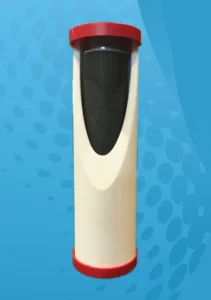
James described CeraUltra as a common starting place for someone who simply says: “I want a good drinking water filter.”
The filter combines a ceramic outer shell with a carbon block core. According to James, the ceramic portion can trap sediment and dirt as well as microscopic pathogenic bacteria that may be present in water.
For someone on municipal water, pathogenic bacteria hopefully aren’t an everyday problem, but things happen.
Boil-water alerts happen.
Infrastructure problems happen.
James calls the ceramic layer a “water insurance policy.”
You don’t necessarily expect to need that protection, but it’s there in case you do.
The ceramic also contains a small amount of silver. James explained that the silver is incorporated into the ceramic during manufacturing to inhibit bacterial growth within the filter. He emphasized that the ceramic itself physically traps the bacteria.
One really interesting benefit: You can clean the ceramic
If you have a lot of iron, sediment, or other particles in your water, they can accumulate visibly on the outside of a ceramic filter.
And instead of immediately throwing away the entire cartridge, you can clean the ceramic surface.
James recommends using a Scotch-Brite-type scrub pad under cool to warm water, with no detergent.
Scrubbing away that outer layer of buildup can restore a slowing flow rate, but that does not reset the lifespan of the filter.
This distinction is important. Cleaning removes physical buildup from the ceramic and helps water flow through it again, but components inside the filter still have a finite useful life.
So please don’t scrub your filter in 2037 and say, “Katie told me this thing lasts forever!” 🤣
I did not.
How dirty is your water?
James showed me a used ceramic filter from Brooklyn, New York. Let’s just say that was a pretty effective advertisement for filtering your drinking water!!
He explained that the municipal water may leave the treatment plant in good condition but then travel through very old infrastructure before reaching someone’s faucet.
In one example, a customer was cleaning the ceramic filter about every fourth day because so much visible material accumulated on it. Eeek! But that’s a pretty extreme example.
Other families, James said, may install a system and never need to clean the filter between normal replacement intervals.
The important point is this: Maintenance depends on your water.
If the flow begins slowing significantly, buildup on the ceramic may be the culprit.
CeraMetix and AquaMetix: When You Want Broader Filtration
From CeraUltra, James moved us into AquaCera’s more advanced filtration options.
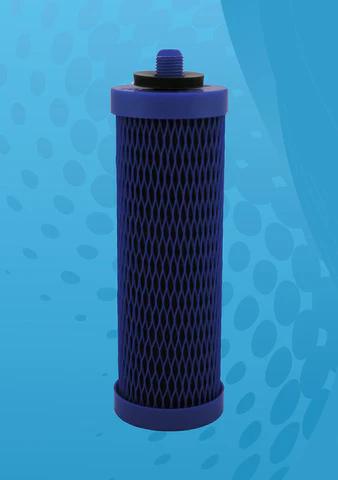
- AquaMetix is a proprietary block made from a blend of carbon and zeolite.
- CeraMetix combines that AquaMetix technology with the ceramic outer shell.
In other words, CeraMetix gives you both the physical ceramic filtration and AquaMetix contaminant-reduction media in one cartridge.
That can be particularly useful when space is limited.
James made a significant claim here, so I want to make sure it remains clearly attributed to him:
He said that, to his knowledge, there are few if any other single filter cartridges on the market that address as many contaminants as CeraMetix for its rated capacity.
And that word capacity matters a lot.
What Does Filter “Capacity” Actually Mean?
This was one of those moments when I realized how easy it is to read a water filter sales page and not actually know what the numbers mean.
A company can say a filter “reduces” something.
Okay.
For how long?
And by how much?
James explained that capacity describes how many gallons a filter can treat for a particular contaminant while continuing to meet a specified reduction level.
Imagine a filter is rated for 1,000 gallons for a certain contaminant. That does not simply mean water can physically pass through it for 1,000 gallons. It means testing has been used to establish that the filter continues reducing that contaminant to the applicable performance level through that capacity.
Eventually, the media reaches a point where it can no longer reduce the contaminant sufficiently to remain above the required performance threshold.
This is why I’m much more interested in seeing what percentage does it reduce, and for how many gallons? than simply seeing a massive list of contaminant names.
James said AquaCera uses laboratory testing to establish both reduction percentages and capacities for the contaminants on its specification sheets.
What about Pesticides and Herbicides?
I specifically asked James about two categories I know many families care about: pesticides and pharmaceuticals.
He explained that pesticides and herbicides can fall under testing for volatile organic compounds, or VOCs. According to James, AquaCera’s CeraUltra has VOC reduction capability that includes pesticides and herbicides.
Pharmaceuticals are a different category. Those fall under what the industry calls emerging contaminants, which have their own testing protocols.
James said AquaMetix and CeraMetix have been tested for certain emerging contaminants and that AquaCera has specific capacity and reduction information for those classifications.
He also noted during our interview that some of AquaCera’s public data sheets needed to be updated with newer testing information. (Note that this interview was in 2019, so I am sure it has been done!)
That’s important context.
I’m a big believer in looking at actual numbers rather than assuming that because a filter says “pharmaceutical reduction,” every pharmaceutical in every concentration disappears forever.
Water is more complicated than that.
Can AquaCera Filters Reduce Fluoride?
Fluoride was another contaminant I specifically wanted to discuss.
James said the AquaMetix media can reduce fluoride. Interestingly, he explained that a two-filter setup may be useful here.
If a carbon filter removes chlorine first, the AquaMetix filter following it has more capacity available for other contaminants, including fluoride. That’s why some consumers choose a CeraMetix cartridge plus an additional AquaMetix cartridge.
Yes, that means more filtration. It also means more equipment.
Welcome back to the original question: How far down the water-filtering rabbit hole do you personally want to go?
What about Estrogenic Compounds?
This one really caught my attention.
The last time I had dug deeply into water filtration research, years ago, estrogenic compounds were particularly difficult to address.
I asked James whether current AquaCera testing includes them, and he said yes.
James placed those compounds within the emerging-contaminant category and said AquaMetix, and therefore CeraMetix, have testing data related to those classifications.
Again, when evaluating a filter, I’d encourage you to look at the actual contaminant data and capacities rather than relying on broad marketing language.
“Reduces contaminants” tells me almost nothing.
Which ones?
How much?
For how long?
Those are much better questions.
How Often Do AquaCera Filters Need to Be Replaced?
Here comes the question every tired parent wants answered:
How much work is this going to add to my life?
James recommends replacing filters generally every six to twelve months, depending on household size and use.
Why use a time recommendation instead of telling people to count gallons?
Because realistically, are you measuring every glass of water your family pours?
I’m not.
And you can’t necessarily taste or smell many contaminants when a filter begins losing effectiveness.
James said a smaller household or individual might sometimes be able to extend replacement beyond that range, but AquaCera uses six to twelve months as a practical general recommendation.
This sounds like a calendar-reminder situation to me! Put it on the calendar, and let your phone remind you. Move on with your life.
If water flow slows before then and you’re using a ceramic filter, you can inspect and clean the ceramic exterior as needed.
James believes one of AquaCera’s biggest strengths is the number of contaminants its more advanced cartridges can address within a single filter.
He also emphasized that AquaCera is a manufacturer focused heavily on filtration technology and research rather than primarily being a marketing company.
AquaCera began as a family-owned business about 30 years ago, and James described the AquaMetix technology as something that took roughly ten years of development to bring successfully into block form.
That is the kind of behind-the-scenes information I find fascinating, because once you realize how much chemistry and material science is happening inside one little cartridge under your sink, it becomes very clear why choosing a water filter based exclusively on price might not give you the whole picture!
My Biggest Takeaway from Talking with AquaCera
You do not need to understand every possible water contaminant before taking one useful step.
That’s good news, because most of us have children to raise and dinner to make.
Start with a few questions.
- Where will the filter go?
- What are your biggest concerns about your water?
- Do you simply want better-tasting water and basic contaminant reduction, or are fluoride, pharmaceuticals, pesticides, and other emerging contaminants priorities for your family?
- How much equipment are you willing to install?
- And how much maintenance will you realistically keep up with?
The answers will narrow your choices quickly.
For me, the appeal of an undercounter setup during our kitchen remodel was obvious. I loved the idea of turning on a dedicated little faucet and getting filtered water without remembering to refill another container on the counter. We ended up going with a different undercounter brand in the end.
Whether you choose AquaCera or another water filtration system, James gave me one excellent framework to carry into future research:
Don’t just ask whether a filter reduces a contaminant.
Ask how much it reduces and for how long.
That question cuts through a whole lot of marketing language.
And after staring into the giant Pandora’s box that is water filtration, I’ll take every bit of clarity I can get.
Nitty-Gritty Details on AquaCera
Average Cost:
CounterTop Systems: approximately $99 to $259 for complete systems
- HCP CounterTop: from $99
- Twin HCP CounterTop: from $169
- HCS CounterTop: from $199
- Terra2 Gravity Systems: from $259
- LP4 Gravity System: from $149
UnderCounter Systems: approximately $179 to $259 for standard in-line systems, plus a reverse osmosis option
- NilusOne InLine System: from $179
- NilusTwo InLine System: from $259
- NilusPRO Premium Reverse Osmosis System: available
Gravity Systems: approximately $149 to $259 for complete systems, with replacement filters from about $29 to $69
- LP4 Gravity System: from $149
- Terra2 Stoneware Gravity Systems: from $259
- Replacement gravity filters include NanoMetix, CeraMetix GF, CeraMetix AMB, AquaMetix, Chemix, CeraPlus, and CeraSyl
Whole House Systems: approximately $899 to $3,199+
- Series 2 Carbon Filter Tank: from $899
- Series 4 Carbon Filter Tank: from $1,299
- Series 6 Backwash Carbon Filter Tank: from $3,199
- Additional whole-house and high-flow options are also available
What It Filters & How Frequently Should the Filters Be Replaced:
CounterTop Systems:
Replacement timing depends on the filter cartridge selected and water usage. AquaCera countertop systems use pressure filters that can be chosen for different contaminant goals, including chlorine, chloramine, lead, fluoride, heavy metals, and PFAS/PFOA depending on the cartridge selected.
UnderCounter Systems:
Replacement timing depends on the filter cartridge selected and water usage. Current in-line systems can be configured with AquaCera pressure filters such as CeraUltra, CeraMetix, AquaMetix, and NanoMetix. Available contaminant reduction may include sub-micron particulate, chlorine, chloramine, lead, fluoride, heavy metals, and PFAS/PFOA depending on the filter chosen. NilusPRO also offers reverse osmosis.
Gravity Systems:
CeraMetix GF Filters: designed for gravity use only. AquaCera says these filters meet or exceed ANSI/NSF Standards 42 and 53 for a wide range of contaminant reductions.
Current reduction claims include:
- Chloramine: >99%
- Chlorine: >99%
- Lead: >99%
- Heavy metals: >98%
- THMs: >98%
- VOCs: >98%
- Glyphosate: >98%
- Pesticides and herbicides: >98%
- Pharmaceutical compounds: >99%
- PFOA and PFOS: >99%
- PFAS: >95%
- Microplastics: >99%
- Radionuclides: >94%
- Nitrates: >92%
- Fluoride: >92%
The cleanable ceramic shell is also described as:
- 0.5 micron absolute
- 99.9% efficient at 0.2 micron
Replace CeraMetix GF filters annually. Current capacities are:
- 5-inch Slimline: 500 gallons
- 7-inch Slimline: 700 gallons
- 9-inch Slimline: 900 gallons
- 5-inch Imperial: 700 gallons
- 7-inch Imperial: 1,000 gallons
CeraPlus: designed for gravity systems with a ceramic shell and activated carbon core.
Current reduction claims include:
- Chlorine: >95%
- Organics: >95%
Additional specs:
- 0.5 micron absolute
- 99.9% efficiency at 0.2 micron
Replace CeraPlus filters annually. Current capacities are:
- 5-inch: 500 gallons
- 7-inch: 700 gallons
- 9-inch: 900 gallons
CeraSyl: designed primarily for sediment and particulate reduction in gravity systems.
Current specs include:
- 0.5 micron absolute
- 99.9% efficiency at 0.2 micron
- Capacity up to 15,000 gallons
AquaCera currently emphasizes turbidity, sediment, and sub-micron particulates here rather than listing a broad chemical-reduction profile.
Chemix: high-capacity, high-flow carbon block filters designed for gravity systems and municipally treated water.
Current reduction/capacity information includes:
- 2,500 gallons for chlorine, taste, and odor reduction
- 450 gallons for lead and mercury
- Independently tested to meet or exceed ANSI/NSF Standards
AquaMetix: gravity block filter designed to reduce a wide range of chemical contaminants.
Current reduction claims include:
- Chloramine: >99%
- Chlorine: >99%
- Lead: >99%
- Heavy metals: >98%
- THMs: >98%
- VOCs: >98%
- Glyphosate: >98%
- Pesticides and herbicides: >98%
- Pharmaceutical compounds: >99%
- PFOA and PFOS: >96%
- PFAS: >95%
- Microplastics: >99%
- Radionuclides: >94%
- Nitrates: >92%
- Fluoride: >92%
Current capacities:
AMX-6GB
- 1,150 gallons for chloramines and chlorine
- 1,150 gallons for heavy metals, lead, and mercury
- 320 gallons for fluoride
AMX-IGB7
- 2,700 gallons for chloramines and chlorine
- 2,700 gallons for heavy metals, lead, and mercury
- 800 gallons for fluoride
AquaCera says AquaMetix filters should be replaced based on usage, and also replaced annually.
Whole House Systems:
Replacement schedules vary by system type. Current AquaCera whole-house options include:
- Series 2 Carbon Systems for chlorine, taste, and odor reduction
- Series 4 Carbon/AquaMetix Systems for chloramines, fluoride, heavy metals, THMs, and chlorine
- Series 6 Backwash Carbon Systems for chloramines, fluoride, heavy metals, THMs, and chlorine
- NoScale salt-free conditioners
- AquaRinse iron and sulfur removal systems
- MR500 and MR700 stainless AquaMetix systems
Examples of current capacity information:
Series 4 Carbon Filter Tank
- CF8: up to 500,000 gallons
- CF10: up to 1,000,000 gallons
- CF105: up to 1,500,000 gallons
- CF12: up to 2,000,000 gallons
Series 6 Backwash Carbon Filter Tank
- CF12: up to 2,000,000 gallons
- CF14: up to 3,000,000 gallons
These whole-house systems are described as low-maintenance, but replacement or rebed timing depends on the model, water conditions, and household use. Some systems also require periodic backwashing rather than simple cartridge replacement.
How Long Does It Take to Filter a Gallon?:
CounterTop Systems: on demand for faucet-connected pressure systems; variable for gravity-fed countertop units
UnderCounter Systems: on demand
Gravity Systems: flow rate varies by filter type, filter size, water level, and filter condition. AquaCera does not present one single gallons-per-hour figure across all gravity filters.
Whole House Systems: on demand


