
- What Is a Berkey Water Filter, Anyway?
- Why Would You Choose a Gravity Filter Instead of a Pitcher?
- Can You Use a Berkey with Lake or River Water?
- One Thing Berkey Does NOT Do: Soften Hard Water
- The Unglamorous Part: You Have to Fill the Thing
- Berkey Filter Maintenance: What You Actually Have to Do
- How Long Do Berkey Filters Last?
- Who Is a Countertop Gravity Filter Really Good For?
- Are There Berkey Alternatives Now?
- So, Would I Still Use a Berkey?
- 2026 Update to Our Original Berkey Interview
- All the Nitty-Gritty Details on Berkey
I grew up spending every summer holiday at my grandparents’ cottage on a tiny lake in gorgeous mid-Michigan. Even though the building has changed a lot over the years, it’s absolutely dripping with nostalgia, memories, and WOW the taste of the tap water!
Hard, hard, iron-tasting water.
And you know what we still use there?
It still makes an impressive difference in that water, which is why I’m not ready to toss the entire category of countertop gravity water filters out with the bathwater. (Or the lake water, as the case may be.)
But I also can’t write about Berkey in 2026 as though the last few years didn’t happen.
There have been consumer lawsuits challenging some of Berkey’s advertising and contaminant-reduction claims, questions about how the old Black Berkey filters were tested, and a lengthy regulatory fight with the EPA.
The EPA issued stop-sale orders involving the old Black Berkey elements, because the filters contained silver and were marketed with antimicrobial claims that the agency said brought them under federal pesticide regulations. That particular EPA action was about how the product was regulated and marketed, not a government finding that Berkey-filtered water was unsafe.
That feels like red tape more than a red flag.
A lawsuit brought by New Millennium Concepts was ultimately dismissed for lack of standing, with that dismissal upheld by the Fifth Circuit and the Supreme Court declining review. A separate case brought by Berkey International, the company that directly received a stop-sale order, has continued through the courts.
There’s another issue that matters just as much to me as a consumer: certification.
The old Black Berkey filters were not NSF/ANSI 53 certified, despite years of extensive third-party testing and some pretty impressive contaminant-reduction claims.
That distinction matters.
Independent laboratory testing can be useful evidence, but testing “to” an NSF standard is not the same thing as having the product certified to that standard with all the ongoing requirements that certification entails.
Today, Berkey is selling a different replacement element called the Phoenix Gravity New Millennium Edition. Certain Travel, Big, and Royal Berkey systems using Phoenix elements are now listed by NSF under Standard 42 for chlorine, taste, and odor reduction and Standard 372 for lead-content requirements in the materials.
Important nerdy detail: Standard 372 does not mean the filter is certified to remove lead from your water.
See Berkey’s current NSF listings here.
So this is not going to be one of those, “Berkey is perfect, everybody buy one!” reviews.
It’s also not going to be, “I read an angry post on the Internet, therefore bury your Berkey in the backyard.”
We can do nuance, right?
I have used a Berkey for years, and there are reasons I still think this type of filter fills a really useful niche.
But there are now competing countertop gravity systems with certifications worth comparing, and I’ll get to those too.
Here’s an (older) interview with a middleman small business owner who was always a Berkey guy.
Can’t see the video? Watch the interview with Jeff Gleason on YouTube.
What Is a Berkey Water Filter, Anyway?
When I interviewed Jeff Gleason of USA Berkey Filters, I started with the most basic question:
What are we actually putting on our kitchen counter?
His answer was basically a giant coffee pot.
Accurate! People have walked into our house, seen ours, and assumed we must consume an alarming quantity of coffee.
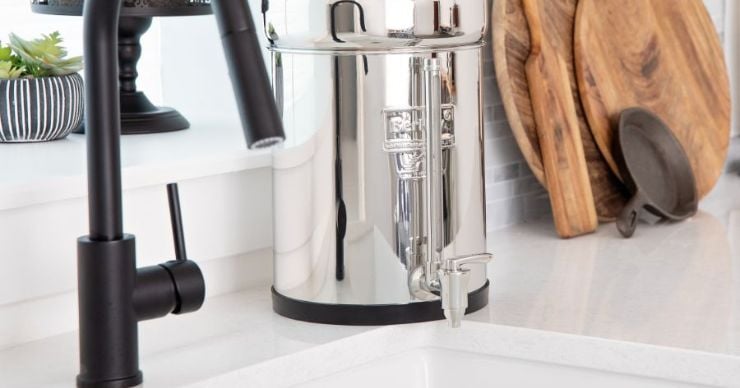
Nope. That giant shiny cylinder is holding water:

Berkey systems are freestanding countertop filters with an upper and lower chamber. Depending on the model, they range from roughly 1.5 gallons for the Travel Berkey to much larger systems intended for big families or groups.
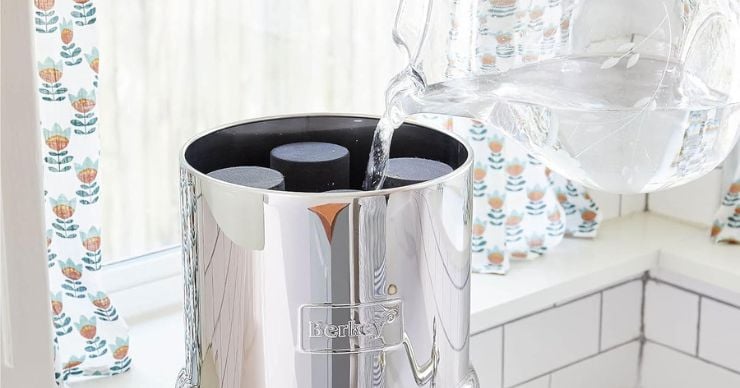
You pour water into the top, gravity pulls it through the filter elements, and filtered water collects in the bottom.
Then turn the little spigot and fill your glass! No plumbing. No electricity. No drilling holes under the sink while your spouse asks whether you’re sure you know what you’re doing.
That simplicity is one of the biggest reasons this category appeals to me.
Why Would You Choose a Gravity Filter Instead of a Pitcher?
There are some very good pitcher filters now, so I don’t think the answer is, “Because pitchers are junk.”
Jeff didn’t either.
The bigger difference is capacity, filtration goals, longevity, and emergency usefulness.
A countertop gravity system can hold gallons rather than a few glasses of water. It doesn’t depend on water pressure or electricity. And because it’s freestanding, renters and people who don’t want to modify their plumbing can use one easily.
That last part has always mattered to me.
In an extended power outage, my under-sink filter might become useless depending on how it operates.
A big stainless steel container that works because Isaac Newton was right about gravity? Still functioning. That’s why even though our “new kitchen” has under-counter filtration, our Berkey is still hanging out in the basement in case of emergency, and I have a ridiculous number of backup filters on standby.
Of course, “works without electricity” is not the same thing as “makes every conceivable water source safe.”
That distinction is important.
Can You Use a Berkey with Lake or River Water?
In our original interview, preparedness was one of Berkey’s big selling points. Jeff talked about using Black Berkey elements with river, lake, and stream water, and that was part of the brand’s historical positioning.
This is an area where I would be more cautious today.
The filter formulation has changed, the certifications have changed, and I would not assume that any current gravity filter can make microbiologically unsafe water safe to drink unless the exact filter you own has testing or certification supporting that exact use.
And no, please don’t plan on drinking the swimming pool.
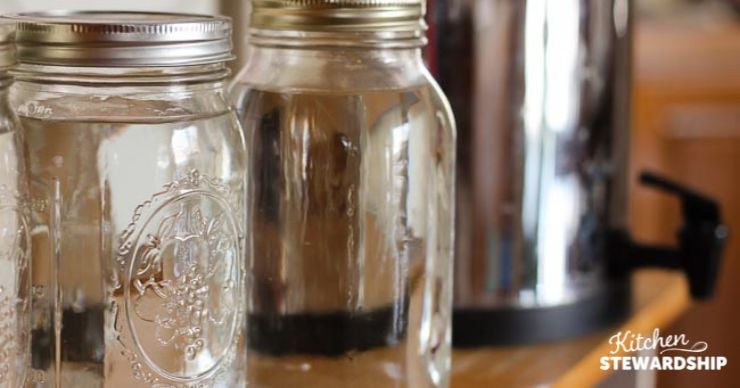
I actually brought that up in my interview as an emergency example, and Jeff stopped me. Drat! Literally eyeing up my neighbor’s pool was always my emergency plan! Mason jars of water in the basement will have to do…or the local stream. 😉
Jeff explained the nuance: a filter may reduce chlorine, but pools can also contain acids, pH-balancing chemicals, salt, and other substances.
He specifically said he could not recommend drinking pool water.
That was a good correction then, and it’s worth repeating now.
(If you want to filter river, lake, and stream water, I’d recommend having a Grayl bottle!)
One Thing Berkey Does NOT Do: Soften Hard Water
Remember my brother’s horribly hard lake-house water?
Here’s an important distinction: The fact that it tastes much better coming through the Berkey does not mean the Berkey is actually a water softener.
Jeff explained that the system leaves minerals such as calcium and magnesium behind, which is why you may still see white mineral residue collecting in the chambers.
Current Berkey information for the Phoenix elements says the same thing: activated-carbon-based filtration does not change water hardness. But boy does a lot of that iron (and the taste) get left behind in the top chamber, thank goodness.
Read Berkey’s current FAQs here.
So if your primary water problem is serious hardness or dissolved iron throughout your house, I’d investigate a proper whole-house treatment system. If the problem is, “I need better-tasting and less harmful drinking water without re-plumbing my kitchen,” that’s a different question.
This is exactly why I don’t believe there is one Best Water Filter for Every Human Ever; you have to know what problem you’re trying to solve.
The Unglamorous Part: You Have to Fill the Thing
This seems obvious until you own one.
An under-sink system gives you filtered water when you turn on a faucet. A gravity filter requires someone to put water in the top.
At our house, we’ve used a pitcher to haul water back and forth, and filling the Berkey is absolutely a kid-assignable job. If you can situate yours close enough to the sink to use your faucet sprayer, even better—but it is still one more household task.
For a family that drinks a lot of water, uses filtered water for cooking, and has multiple children filling giant water bottles before school? Refilling it gets to be a lot. You better buy a big enough Berkey! Their options go from 1.5 gallons (Travel) to the 2.25 gallon Big Berkey all the way up to a 6-gallon Crown model.
Otherwise you will inevitably walk over thirsty and discover three tablespoons of water remaining because everyone in the family apparently thought refilling it was someone else’s spiritual gift.
Hot tip: when it’s low, you can tip it (carefully!) and get a glass full out, then refill asap.
Hot tip #2: don’t assign the refill job to a babysitter without explaining a little bit about how it works. We had a sitter refill it once, then peek in the top later, see that it was low again, and refill it again. And again. She left for the day, and a few gallons of water spilled all over our kitchen, about 20 ft. in diameter. Ouch!
Berkey Filter Maintenance: What You Actually Have to Do
This was one of the most useful parts of my conversation with Jeff because countertop gravity filters aren’t entirely “set it and forget it.”
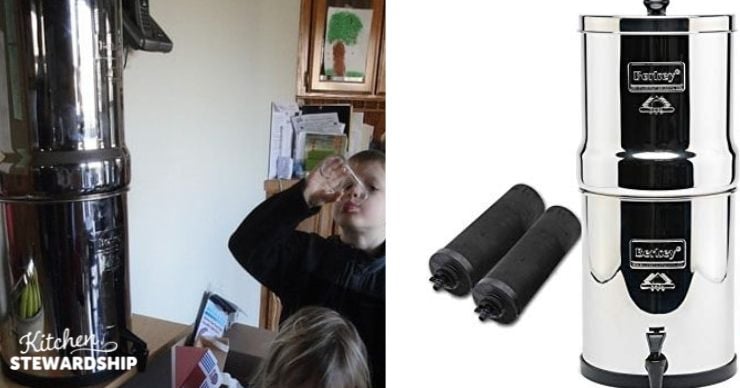
The old Black Berkey elements had to be primed before use. If the flow slowed because of sediment or mineral buildup, they could be cleaned and re-primed. The stainless steel chambers could be cleaned with soap and water, and Jeff recommended vinegar for hard-water mineral deposits on the chamber itself.
If you try to use the filters without priming, it will take half a day to filter water that should take about an hour! Some friends of mine bought a Berkey on my recommendation for their cottage, and after a week, they were throwing their hands up in despair and complaining loudly. I finally figured out that they hadn’t primed the filters. Once they did, it was like a totally different tool!
The new Phoenix elements also require priming. Current instructions say that if flow slows or debris or scale builds up, you can scrub the elements under cold running water with a stiff brush or Scotch-Brite pad, re-prime them, and reinstall them.
Do not put soap or cleaners on the filter elements themselves.
What About the Berkey Red Food Coloring Test?
Jeff and I talked about the famous red food coloring test as a way to determine whether filters were still working.
I would phrase that differently today.
Current Phoenix instructions describe the red food coloring test primarily as an assembly verification test. If red gets through, there may be a bad seal, improperly installed filter, or another pathway allowing unfiltered water through.
Passing that test does not prove that your filter is still reducing every contaminant on a laboratory report at its claimed percentage. That’s a pretty important distinction.
A clear glass of water after the red dye test tells you something useful. It does not turn your kitchen into an NSF laboratory. But dang it feels very convincing!!!
How Long Do Berkey Filters Last?
In our original interview, Jeff said his Black Berkey elements often lasted four or five years, with a historical manufacturer rating of up to 6,000 gallons per pair.
Those were the old Black Berkey elements.
The current Phoenix elements are a different product.
USA Berkey Filters currently recommends replacement at about 2,750 gallons per element, or 5,500 gallons for a pair, with the warning that actual life can be shorter depending on the quality of the incoming water.
So I would not buy a current Berkey based on an old article promising, “Your filters will last five years!”
How many gallons you actually get depends on your water and your household.
Who Is a Countertop Gravity Filter Really Good For?
This is where I think the category still has a lot going for it.
I’d seriously consider one for:
- A cottage or cabin
- A rental
- An older home where plumbing modifications are a pain
- A family that wants a lot of filtered drinking water
- A household that values having a water-filtration option that doesn’t require electricity
I would look elsewhere if:
- Counter space is precious
- You know you’ll resent filling another container
- You need to soften your whole house
- You’re dealing with one specific contaminant for which another technology has much stronger certification
That last one deserves bold letters in your brain:
Choose your filter based on your water.
If lead is your concern, look for certification for lead reduction.
If PFAS is your concern, look for certification or strong third-party testing for the specific PFAS compounds involved.
If you have well water, test it.
If your biggest complaint is chlorine taste, your needs are very different from someone whose water test comes back with arsenic.
Start with the problem and do the research for the solution.
Are There Berkey Alternatives Now?
Yes, and I think this is good news.
My firsthand experience is with Berkey, so I’m not going to pretend I’ve personally put all of these systems through years of family abuse.
But if you like the gravity-fed countertop concept, there are several systems I would compare before buying.
| Gravity System | Why I’d Compare It |
|---|---|
| BOROUX | Stainless steel gravity system. Its published performance sheet makes clear which claims are certified and which come from other testing. |
| British Berkefeld SS2 | An especially interesting comparison because NSF’s own database currently lists the Ultra Sterasyl gravity system under Standards 42, 53, 401, and 372, with specific certified claims including cyst/turbidity and microplastics reduction. |
| ProOne Big+ | Another gravity-fed option. ProOne reports IAPMO certification against standards for specific claims such as lead, total PFAS, and microplastics. As always, check the certification for the exact system and filter you’re buying. |
I’m much happier telling you, “Here are multiple products in the category and here’s how to evaluate the evidence,” than pretending loyalty to one brand should determine what comes out of your family’s faucet.
So, Would I Still Use a Berkey?
I do.
One is still in heavy use at my generational family lake house, dealing with some seriously unpleasant-tasting water.
That personal experience counts for something. It tells me that a large gravity-fed countertop filter can be incredibly useful, particularly when you want something portable, electricity-free, and capable of handling a lot of family drinking water.
It doesn’t tell me that every historical Berkey marketing claim was perfect, and it definitely doesn’t tell me that you should choose Berkey without looking at the newer options.
In fact, one of the things I said to Jeff in our original conversation still sums up my opinion pretty well:
I don’t think there’s one singular best filter ever.
There’s probably a best choice for your situation.
- Figure out what’s in your water.
- Decide whether you need filtration, purification, or actual water softening.
- Look at the specific contaminant claims that matter to you.
- Check whether those claims are independently certified or merely tested.
Then be honest about your real life.
Counter space matters.
Filter cost matters.
Whether your kids will actually refill the giant silver coffee pot matters.
That’s not as satisfying as declaring one product the winner, but it’s a much better way to choose the water your family drinks every day.
2026 Update to Our Original Berkey Interview
2026 Update: This interview discusses the original Black Berkey filter elements in 2019, which are no longer the standard replacement filters available through normal authorized U.S. distribution. Berkey now offers Phoenix Gravity New Millennium Edition elements, with different specifications, testing, capacity, and certification. I’ve updated the article around the interview so you can distinguish between historical information and what’s available today.
Read more about current Berkey replacement filters here.
One more important note: The original interview includes historical claims about pharmaceutical reduction, glyphosate reduction, filtering untreated surface water, and a 6,000-gallon filter lifespan. Those statements referred to the original Black Berkey elements.
If you’re shopping for a filter today, evaluate the testing, certifications, and specifications for the exact filter element currently being sold, rather than relying on claims from an older Berkey review or interview.
All the Nitty-Gritty Details on Berkey
Average Cost:
Current Berkey systems are sold in several sizes, and the price depends on the canister and filter configuration.
For the stainless steel models currently listed by NSF with the Phoenix Gravity New Millennium Edition filters, expect to spend roughly:
- Travel Berkey, 1.5 gallons: about $310 with a pair of Phoenix filters
- Big Berkey, 2.25 gallons: about $354 with a pair of Phoenix filters
- Royal Berkey, 3.25 gallons: about $399 with a pair of Phoenix filters
Berkey also makes larger 4.5-gallon Imperial and 6-gallon Crown systems.
Current Phoenix replacement filters are about $120 per pair. Prices change, of course, because apparently even gravity has inflation now.
What It Filters:
Important update: Berkey replaced its original Black Berkey elements with the Phoenix Gravity New Millennium Edition filters. Older Berkey reviews, including our original interview, may include contaminant, lifespan, and flow-rate claims that do not apply to the filters currently sold.
The current Travel, Big, and Royal Berkey systems equipped with Phoenix elements are NSF/ANSI 42 certified for chlorine reduction and taste and odor reduction. They are also certified to NSF/ANSI/CAN 372, which addresses lead content in the materials used to make the system. Standard 372 does NOT mean the filter is certified to remove lead from drinking water.
Berkey also publishes third-party laboratory testing for the Phoenix filters showing reduction of a much broader list of contaminants, including:
- PFAS compounds, including PFOA and PFOS
- Heavy metals such as lead, arsenic, mercury, cadmium, chromium, uranium, and iron
- Chlorine and chloramines
- Trihalomethanes and other disinfection byproducts
- Pesticides and herbicides, including glyphosate
- Tested pharmaceuticals
- VOCs and SVOCs
- Petroleum-related contaminants
- PCBs
- Nitrates and nitrites
- Fluoride
- Some radiological contaminants
- Sediment, rust, cloudiness, bad tastes, and odors
Those broader contaminant claims are based on Berkey’s published laboratory testing and should not be confused with contaminants for which the system has NSF certification.
Maintenance/Upkeep:
Rated: Monthly/as needed
The Phoenix filters need to be primed before use.
If the flow rate slows or you notice sediment, scale, or mineral buildup on the outside of the filters, Berkey recommends removing them and gently scrubbing them under cold running water with a stiff brush or Scotch-Brite-type pad.
Do not use soap or cleaning agents on the filter elements themselves.
After cleaning, re-prime the filters, reinstall them, and perform the red food coloring test to make sure everything is properly sealed.
The stainless steel chambers themselves can be cleaned separately. Mineral buildup in the chambers can be addressed with vinegar.
And, yes, there’s the most basic maintenance of all:
Someone has to fill it.
A Berkey isn’t connected to the plumbing. You add water to the top chamber and gravity does the rest. In our family, that makes “fill the Berkey” a perfectly reasonable kid job.
How Often Do the Filters Need to Be Replaced?
The current Phoenix elements are recommended for replacement at approximately:
2,750 gallons per filter, or 5,500 gallons per pair.
They may need replacement sooner depending on the quality of your incoming water.
This replaces the old recommendation we discussed in the interview that Black Berkey elements could last four to five years or up to 6,000 gallons.
Those numbers referred to the old Black Berkey elements, not the Phoenix filters currently being sold.
Sizes:
Berkey’s stainless steel systems range from approximately:
- Travel Berkey: 1.5 gallons
- Big Berkey: 2.25 gallons
- Royal Berkey: 3.25 gallons
- Imperial Berkey: 4.5 gallons
- Crown Berkey: 6 gallons
The Travel, Big, and Royal systems equipped with Phoenix filters are the models currently appearing in NSF’s official Berkey listings for Standards 42 and 372.
Different capacities make sense for different households, but remember that capacity isn’t just about the number of people in your family.
Think about how much filtered water you use for drinking, filling water bottles, coffee and tea, cooking, pets, and all those other little uses that somehow empty the container approximately six seconds before you arrive with your own glass.
How Long Does It Take to Filter a Gallon?
The current Phoenix filters have a published flow rate of up to 4.2 gallons per hour per pair when the upper chamber is full.
At the maximum rate, that’s roughly one gallon every 14 minutes.
But that’s not a constant rate.
Gravity filtration slows as the water level in the upper chamber drops, so actual filtration time will vary. Berkey also says flow can be faster when the Phoenix elements are installed in larger systems because there is more water pressure above them.
What About Fluoride and Arsenic Filters?
Berkey still sells its separate PF-2 Fluoride and Arsenic Reduction Elements, and USA Berkey Filters currently states that the Phoenix elements are compatible with them.
The Phoenix filters themselves also have published third-party testing for fluoride reduction.
Because Berkey’s filter lineup and documentation have changed considerably since our original interview, I would check the current instructions for the exact filter combination you’re purchasing rather than relying on older articles about Black Berkey elements.
Glyphosate Testing:
The old information in this post referred to an independent 2019 test of the original Black Berkey filters.
Since those filters have been replaced, I wouldn’t use that old “100% glyphosate removal” result as evidence for the Berkey someone buys today.
The Phoenix filter has its own laboratory testing.
Current published third-party testing reports very high reduction of glyphosate under the laboratory test conditions, along with testing for other pesticides, herbicides, VOCs, SVOCs, and pharmaceuticals.
Again, the important distinction is that these are laboratory test results, not an NSF-certified glyphosate claim.
Reference:
- The Fifth Circuit Decision on Berkey Filters, https://www.ca5.uscourts.gov/opinions/unpub/23/23-11189.0.pdf.


