
- First, take some pressure off yourself: Any filtration is a step in the right direction
- “Safe” water and really clean water aren’t necessarily the same goal
- The phrase that got my attention: “emerging contaminants”
- Don’t just ask, “Does this filter work?”
- Here’s what I’d look for before buying a water filter
- Why flow rate matters more than I realized
- Consider two layers of filtation
- And please don’t forget about filter changes
- If you’re prioritizing organic food, don’t forget the water
- My biggest takeaway from Aquasana
- All the Nitty-Gritty Details on Aquasana
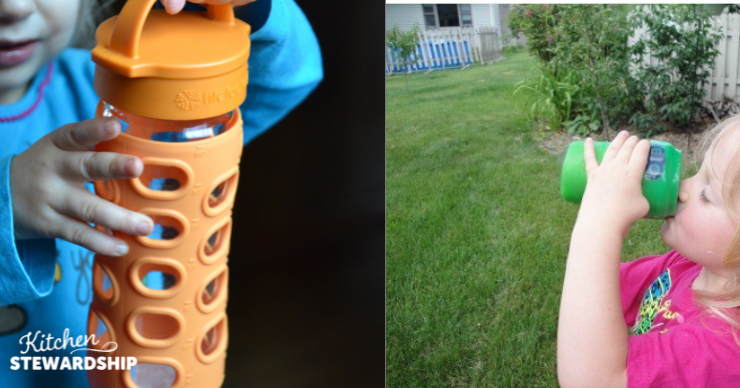
When she was in grade school, my daughter did NOT like the taste of the water fountain at school. So when we got an Aquasana filtered water bottle to try, she was immediately intrigued.
“Can I put it together? Can I try it?”
Absolutely. Have at it.
The funny part came when she filled it. “This is so weird,” she said, filling her water bottle straight from our kitchen tap.
We’d used a countertop water filter for years, so drinking water directly from the faucet felt completely foreign to her. I had to laugh, but it also made me realize that my kids have grown up assuming filtering our drinking water is just something our family does.
And the more I learn about what may be in our water, the more I’m glad for that.
I sat down with Derek Mellecamp, general manager of Aquasana, to talk about water filtration, what filters can actually remove, and how overwhelmed families can make a smart choice without earning a PhD in water chemistry first.
Because good GRIEF, water filters can get complicated fast.
First, take some pressure off yourself: Any filtration is a step in the right direction
One of my favorite things Derek said came right at the beginning of our conversation: Any filter is better than no filter.
Thank you. Can we put that on a little sign next to the 4,829 water-filter comparison charts on the Internet?
If you’ve started researching water filtration and suddenly found yourself comparing carbon blocks, flow rates, filter media, certifications, replacement schedules, and contaminants you didn’t even know existed yesterday, you know exactly what I mean. It’s very easy to come down with a serious case of decision paralysis trying to find THE BEST water filter.
I don’t think there is one best filter for every family. There’s the best option for your home, your water, your budget, and what you’re trying to accomplish.
We’ve already covered the pros and cons of various water filter styles at Kitchen Stewardship®, so I’m not going to make you sit through another countertop-versus-undercounter-versus-whole-house dissertation here. (Read about it in this post.)
What interested me much more in this conversation was a simpler question:
What are we actually trying to get OUT of our water?
Because that’s where things get interesting.

“Safe” water and really clean water aren’t necessarily the same goal
Most of us turn on the faucet without thinking too hard about where that water has been. That’s understandable, because we have enough to think about before breakfast.
But municipal water treatment and home water filtration aren’t necessarily solving the exact same problem. Derek explained that Aquasana pays particular attention to contaminants beyond obvious chlorine taste and odor, including substances such as lead, mercury, chloramines, pharmaceuticals, and PFOA/PFOS.
Some contaminants may originate in the water supply, while others can enter somewhere between the treatment facility and your glass. Older plumbing, for example, may introduce lead.
That means the question isn’t simply, “Is my city water treated?” It’s also, “What could be in the water by the time it reaches my family?”
The phrase that got my attention: “emerging contaminants”
During our interview, Derek kept using the phrase emerging contaminants, and I stopped him because that sounded suspiciously like technical language normal people nod along to without actually knowing what it means.
Basically, he explained, these are substances we’re learning more about (and becoming increasingly concerned about) in water. They aren’t necessarily brand-new chemicals floating around for the first time last Tuesday.
Instead, testing, research, and standards are beginning to catch up with contaminants that may already be present.
One example we discussed was pharmaceuticals, and that one has bothered me for YEARS.
When I had researched water filtration about seven years before this interview, I was especially concerned about estrogenic compounds from pharmaceuticals. At the time, I was told filters couldn’t prove they removed them because there wasn’t an established testing standard to demonstrate it.
According to Derek, that’s one of the things that had changed by 2019. Testing standards had caught up, and Aquasana had pursued NSF 401 certification for reduction of certain emerging contaminants, including pharmaceuticals.
And that brings me to what may be my biggest practical takeaway from this whole interview.

Don’t just ask, “Does this filter work?”
Ask what it has been certified to reduce.
Those are very different questions.
A package can say all sorts of lovely things: “clean,” “pure,” “advanced,” “premium.” Wonderful. My shampoo bottle also has adjectives.
I want data!
Derek explained that Aquasana uses multiple filtration technologies together, because different types of filtration media can address different contaminants. More importantly for us as consumers, their systems are independently tested and certified for specific contaminant reduction.
The particular three-stage system we discussed at the time was certified to reduce 77 contaminants. That’s far more useful information to me than a generic promise that a filter “improves water quality.”
In fact, I accidentally gave Derek a perfect opportunity to demonstrate why we should look at actual performance data.
I asked him what percentage of estrogen-related compounds the filter removed.
“I want to hear a big number,” I joked. “It’s like The Price Is Right. Big money!”
He remembered that it was above 99%, but he didn’t want to give me a more precise number without checking Aquasana’s performance sheet.
GOOD.
That’s exactly what I want from someone talking about health-related technology. Don’t make up the decimal point because it sounds impressive. Check the data.
For parents researching a water filter, that’s a great practice to copy.
Here’s what I’d look for before buying a water filter
Instead of beginning with, “Which brand does everyone on Facebook like?” I’d start with questions that tell me something meaningful about how a filter will actually serve my family.
- What contaminants am I most concerned about in my home or local water?
- Is this exact filter independently certified to reduce those contaminants?
- Can I find the performance data showing what was tested?
- How often does the filter need to be replaced?
- Will I realistically keep up with that maintenance?
- How much water can it filter effectively, and at what flow rate?
- What will replacement filters cost me over time?
Notice that “Is it pretty?” didn’t make my list. Although if you’re drilling a faucet into a beautiful countertop, I will allow some aesthetic opinions.
Why flow rate matters more than I realized
Here’s one bit of water-filter science that finally clicked for me during this conversation: Filtering depends partly on contact time.
The water has to spend enough time interacting with the filtration media for that media to do its job. That explains why filtering every gallon entering a house is a different challenge from thoroughly filtering the smaller amount you’re about to drink.
If you’re simultaneously running a shower, filling a bathtub, doing laundry, and turning on a faucet, that’s a LOT of water moving through a whole-house system. You still may want filtration at that level, particularly if reducing things like chlorine throughout the home is your goal, but more intensive drinking-water filtration can operate differently (and I would posit, more effectively!), because there’s much less water moving through at once.
In the interview I summarized it this way: If we tried to filter absolutely everything entering the house as intensely as our drinking water, we’d be taking showers in drips.
Derek laughed and basically agreed.
Water physics lesson accomplished.
Consider two layers of filtation
Aquasana came onto my radar through people I trust who care deeply about building healthier homes, including my friend Ryan and healthy-home consultant Andy Pace.
The approach that makes sense to me is fairly simple: Do a solid job filtering water as it enters the house, then do an even more thorough job on the water we’re actually drinking.
I’m not telling you that’s what every family needs to do. If you’re renting, your options will look different. If your budget is tight, they may look different, and if your local water presents a particular concern, your priorities may be completely different from mine. Aquasana offers many different options, from whole-home systems to the countertop Clean Water Machine as well as undercounter models.
And please don’t forget about filter changes
You know what can make a very expensive filter less impressive? Not changing the filter.
It’s the least noticeable part of water filtration, and probably one of the most important. The Aquasana point-of-use filters Derek described generally needed replacement about every six months, and their system alerts users when it’s time. (As someone using a filter that doesn’t alert me, that sounds glorious! It’s too easy to either (a) miss my calendar reminder or (b) get into decision fatigue wondering if the filter is actually necessary to change or if we could eke 2 more or 6 more months out of it!)
They also offer automatic filter shipments, and I am a HUGE fan of anything that removes a recurring task from my brain.
Derek also described changing his own filters, which took him just a couple of minutes. The system shuts off the water when the cartridge is twisted out, so the process doesn’t require a plumbing adventure twice a year.
And yes, depending on your water, you may get the deeply satisfying experience of pulling out a gross brown filter and thinking:
HA. I didn’t drink you.
I appreciate that kind of tangible reinforcement.
If you’re prioritizing organic food, don’t forget the water
Near the end of our conversation, Derek made a point that stuck with me: If you’re spending extra money to source good food, water deserves some attention too.
We drink it. We cook with it, our kids carry it to school, we make coffee and tea with it, we boil pasta in it, and we use it in approximately four billion kitchen tasks.
For many Kitchen Stewardship® readers, food sourcing gets a tremendous amount of thought. We’re researching organic strawberries versus conventional, grass-fed beef, pastured eggs, cooking oils, flour, and all the other decisions that somehow follow us home from the grocery store.
We research the dickens out of our groceries.
It’s worth asking what’s in the ingredient coming out of the faucet too.
I don’t say that to give you one more thing to worry about! Quite the opposite: Water filtration is one of those healthy-home choices that, once you’ve made a good decision, can require relatively little ongoing brain space.
Choose your system, maintain it, drink your water, and carry on with life. Done.
My biggest takeaway from Aquasana
Derek closed our conversation almost exactly where he began: Filter your water.
Aquasana won’t be the perfect option for every person, and he readily said so. I appreciated that, but I also appreciated learning more about what really separates one filter from another: contaminant reduction, testing, certification, contact time, and whether the system is realistic enough that you’ll actually maintain it.
That’s where I’d start.
Not with fear, and not with the idea that you need the fanciest system immediately. Definitely not with eleventy dozen open browser tabs until midnight.
Start with your water and figure out what you want to reduce. Look at actual certification and performance data, then choose the best option your family can reasonably install, maintain, and afford.
That’s Kitchen Stewardship® in a nutshell, isn’t it?
Take care of your family, make an informed choice, and don’t go crazy doing it.
Want to dive deeper into the different types of filters and figure out which setup makes sense for your family? Start here!
All the Nitty-Gritty Details on Aquasana
Average Cost:
Whole house: About $2,000-$5,800+, depending on the system and configuration. The standard Rhino is currently listed at $1,998, Rhino Max Flow at $2,798, and the newer HealthShield systems cost considerably more. Optional upgrades like UV filtration, a salt-free water conditioner, and bypass kits add to the price. Sales are common, so actual purchase prices may be significantly lower.
Under-counter filters for individual sinks: About $250-$450 at regular price. Current models range from the $249.99 Claryum 2-Stage or Direct Connect to the $449.99 Claryum 3-Stage Max Flow. Aquasana’s Water for Life program currently discounts systems and replacement filters, and additional sales may lower prices further.
What It Filters:
Whole house: This varies quite a bit by model.
- Rhino: Primarily designed for chlorine reduction, reducing up to 97% of chlorine for up to 1,000,000 gallons. It also incorporates sediment filtration.
- HealthShield: Aquasana’s newer, more comprehensive whole-house option reduces up to 99.9% of 61 contaminants, including PFAS “forever chemicals,” VOCs, pharmaceuticals, chlorine, chloramines, herbicides, pesticides, and BPA. It is WQA tested and certified to NSF/ANSI Standards 53 and 401 for specified claims.
- Optional UV filtration can be added to address bacteria and viruses.
Under counter: Aquasana’s Claryum under-sink systems reduce up to 78 contaminants, including:
- Disinfectants: chlorine and chloramines
- Metals: lead and mercury
- PFAS: including PFOA and PFOS
- Solids: microplastics and asbestos
- Biological contaminants: cysts including Giardia and Cryptosporidium
- Chemicals: VOCs, pharmaceuticals, herbicides, and pesticides
The current Claryum 3-Stage Max Flow, for example, is certified to reduce 99.6% of lead and microplastics, 99.7% of PFOA/PFOS, 99% of VOCs and asbestos, 97.3% of chlorine, and 91% of chloramines.
Maintenance/Upkeep:
Whole house: Monthly to yearly maintenance, depending on components.
The main Rhino tank lasts up to 10 years or 1,000,000 gallons, whichever comes first. The newer HealthShield tank lasts approximately 2 years or 165,000 gallons.
However, the main tank isn’t the only maintenance to consider. Aquasana recommends replacing the standard whole-house pre-filter every 2 months and the post-filter every 6 months. Their upgraded low-maintenance pre-filter lasts 6 months, and an optional UV lamp is replaced yearly.
Under counter: About every 6 months.
Aquasana recommends replacement every 3-6 months depending on the model and gallon capacity. The Claryum 3-Stage Max Flow lasts up to 800 gallons or 6 months, while other Claryum systems range from about 500-784 gallons or up to 6 months.
How Long Does It Take to Filter a Gallon?
Whole house: On demand. The standard Rhino has a rated flow rate of 7 gallons per minute and a peak flow rate of 14.6 GPM. Aquasana says its whole-house tanks can provide flow rates of up to 14+ GPM depending on the system.
Under counter: On demand. Water is filtered as you use the dedicated faucet rather than being collected in a holding tank. The current Claryum 3-Stage Max Flow has a 44% faster flow rate than Aquasana’s standard 3-Stage model.


