
- What Is a Whole House Water Filter?
- Where Does a Whole House Water Filter Go?
- Can You Install a Whole House Water Filter Yourself?
- How Does a Whole House Water Filter Work?
- Whole House Water Filter vs. Reverse Osmosis
- Do You Still Need a Drinking Water Filter With a Whole House System?
- What’s the Biggest Advantage of a Whole House Water Filter?
- How Long Does a Whole House Water Filter Last?
- What Size Whole House Water Filter Do You Need?
- Who Is a Whole House Water Filter Best For?
- Why We Chose an Under-Counter Water Filter Instead
- Our Radiant Life Direct Connect Plus Review After Five Years
- So, Is a Whole House Water Filter Worth It?
- All the Nitty-Gritty Details on Radiant Life Whole-Home Filtration Systems
I’ve spent a lot of years thinking about what comes into our house, what goes into our bodies, and how many separate filters one human being should reasonably be expected to remember to replace.
Back in 2019, I had a drinking water filter, a bathtub filter, and a shower filter, and I admitted to Tom from Radiant Life that I was not exactly winning awards for my filter-maintenance skills.
I would take my supplements upstairs at night, realize the filtered water was downstairs, and think, “Eh, the chlorine has had 12 hours to evaporate out of this glass of tap water. That counts for something, right?”
Meanwhile, I could rarely remember how long the shower or bathtub filters had been installed. So when I interviewed Tom about whole-house water filtration, the idea sounded pretty appealing.
What if we could filter the water once, right when it entered the house, instead of putting separate filters on everything and then expecting my brain to keep track of them all?
I went into that conversation thinking a whole-house filter might be the answer for us.
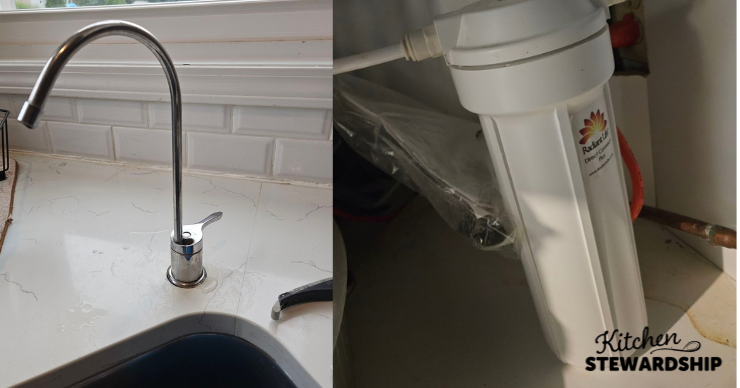
Years later, I can tell you that we ended up choosing a different Radiant Life system, the Direct Connect Plus, which is an under-counter filter for the water at our sink.
That decision doesn’t make the whole-house conversation any less useful, though. In fact, understanding what a whole-house filter does, and what it doesn’t do, helped me figure out what our family actually needed.
So if you’re looking at water filtration and wondering whether a whole-house system is worth it, let’s start there.
Can’t see the video? Check it out on YouTube instead.
What Is a Whole House Water Filter?
A whole-house water filter is exactly what it sounds like: Instead of filtering water at one faucet, it filters the water near the point where your main water supply enters the house.
That means the water has already passed through the filtration system before it heads to your kitchen sink, bathrooms, showers, or bathtub.
This is why you’ll also hear whole-house filters called point-of-entry filtration systems.
That’s different from an under-counter filter like the Direct Connect Plus we eventually chose, which is a point-of-use system. It filters the water at one particular sink, which is great if your primary concern is drinking and cooking water, but it isn’t doing anything to the water in your upstairs shower.
That distinction seems obvious once you understand it, but it was one of the most helpful things for me to get clear on while I was researching.
Where Does a Whole House Water Filter Go?
Tom told me that a whole-house system is typically installed just after the main water shutoff, wherever the water first enters your home.
These are not cute little filters hiding under your kitchen sink.
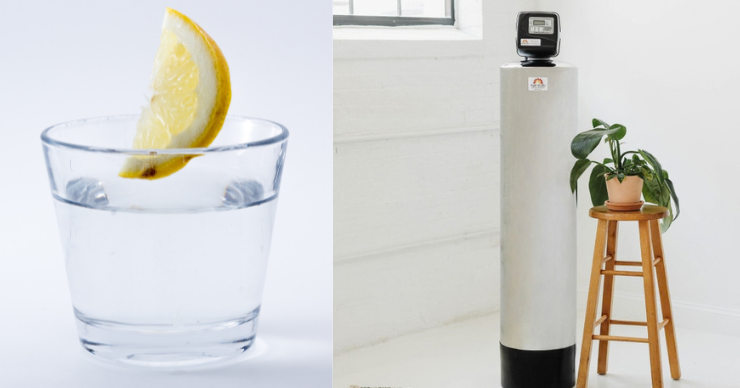
The systems we discussed were generally around five or six feet tall and roughly a foot in diameter, so you need an appropriate location for one. Depending on your house, that could be a basement, garage, utility area, or another place near the main water line.
And here’s a little bonus homeowner life skill Tom brought up during our conversation:
Do you know where your main water shutoff is? Apparently we’re all supposed to know this.
(I’ll give you a minute to find it…just don’t get distracted by your squirrel brain and forget to finish reading!)
Can You Install a Whole House Water Filter Yourself?
Technically, I’m sure there are people reading this who could (like Jess at Scratch Mommy).
I am not one of those people!
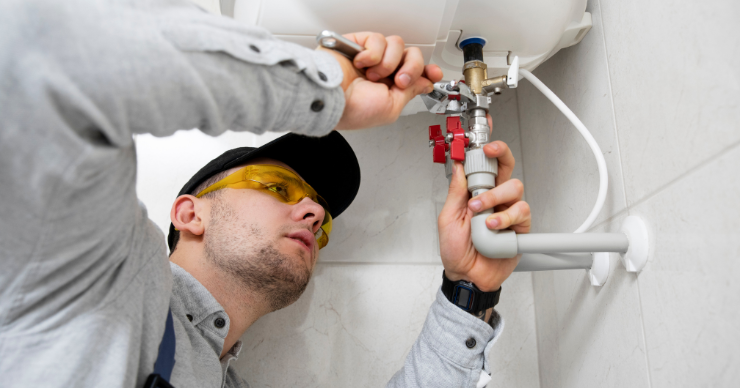
Because a whole-house filtration system connects to your main water supply and needs to comply with local plumbing requirements, Tom recommended having a qualified plumber do the installation.
There may be some amazing DIY people who hear “cut into the main water line” and think, “Sounds like a Saturday project!” At my house, that sentence means, “Find the plumber’s phone number.”
Know thyself.
How Does a Whole House Water Filter Work?
The whole-house systems Tom described use granular activated carbon, sometimes combined with other specialty filtration media, to reduce contaminants as water flows through the system.
Activated carbon is commonly used to reduce things like chlorine and chloramines, and Tom also talked about its ability to reduce certain volatile organic compounds, pesticides, herbicides, pharmaceuticals, and endocrine-disrupting chemicals.
This is where water-filter shopping gets complicated very quickly, because there’s a big difference between saying that a filtration material can reduce something and knowing exactly how well a particular filter reduces it.
I’m a details person.
If you tell me a filter “removes contaminants,” my next seventeen questions are going to be, “Which contaminants? How much? According to whom? Under what conditions?”
I’d encourage you not to shop based on a giant list of scary chemicals alone.
Look at what’s actually IN your water, decide what you care most about filtering, and look at the testing for the product you’re considering (preferably third party if it’s available).
Whole House Water Filter vs. Reverse Osmosis
I also asked Tom about reverse osmosis because, like a lot of people, I tended to think of RO as the most serious version of water filtration. But an RO system and a whole-house carbon filter are really serving different purposes.
The whole-house systems we discussed rely primarily on activated carbon and other filtration media. Reverse osmosis is more commonly used at a particular drinking-water faucet, where water passes through an RO membrane for more extensive purification.
Tom explained that reverse osmosis also removes minerals from the water, which is why some systems add minerals back after filtration. (Mary talks about that more in her contributor post here.)
So I wouldn’t look at this as a contest where one kind of filter needs to beat the other. The more useful question is what kind of water you want at each point in your home.

Do You Still Need a Drinking Water Filter With a Whole House System?
This was one of the more surprising parts of my conversation with Tom. I had assumed that if you went to the trouble and expense of installing a whole-house filter, you’d be done.
No more filters.
Congratulations, you have completed “water”!
But Tom actually recommended pairing whole-house filtration with an additional point-of-use filter for drinking and cooking water.
Part of the reason is that the two systems are doing different jobs.
- The whole-house filter reduces contaminants before the water moves throughout your home.
- A point-of-use filter gives your drinking water another level of filtration right before you use it.
Tom also mentioned that plumbing itself, particularly in older homes, can potentially introduce contaminants after the water has already gone through the whole-house system.
So it doesn’t necessarily have to be whole house or under sink. For some families, the right answer could be both.
What’s the Biggest Advantage of a Whole House Water Filter?
For my thinking, it was convenience.
A kitchen filter takes care of the kitchen sink.
A shower filter takes care of one shower.
A bathtub filter takes care of the bathtub.
Then you replace each of those filters on its own schedule, which sounds perfectly reasonable until you are standing in the shower one morning wondering whether you changed that filter six months ago or sometime during the previous presidential administration.
A whole-house system simplifies that enormously because the water is filtered before it reaches all those places. That means filtered water for bathing, brushing teeth, washing up, and filling a glass from a bathroom faucet when someone suddenly realizes at bedtime that they have apparently been crossing the Sahara for three days.
For someone like me, fewer individual filters to track is not a small advantage!
How Long Does a Whole House Water Filter Last?
This was another part that caught my attention.
Tom told me the Radiant Life whole-house systems are generally sized to provide around 10 years of filtration, depending on your household size, water use, incoming water quality, and how much capacity you purchase.
He suggested testing the water around year eight to see how well the system is still performing rather than automatically replacing it based only on the calendar.
Of course, “10 years” sounds fantastic when you’re standing there remembering that you forgot to change the shower filter again, but this is also where I think you have to do the math. Longer-lasting doesn’t automatically mean cheaper, and it doesn’t automatically mean it’s the best use of your money if your main goal is drinking water. (Spoiler: I went with less expensive!)
What Size Whole House Water Filter Do You Need?
Whole-house systems are generally sized according to your home’s peak water demand, which means the number of bathrooms is useful, but it isn’t the whole story.
Tom explained that what really matters is how much water your family is likely to be using at once.
You might have five bathrooms because of the way your house was built, but if only three people live there and nobody is running four showers simultaneously, your needs are different from another five-bathroom home with a huge family.
A larger system may also last longer because you have more filtration capacity.
This is one of those purchases where I would absolutely talk to an actual human who understands the equipment rather than clicking the biggest option because the chart told me I have the corresponding number of bathrooms. I love that Radiant Life is a small, woman-owned business that does this kind of consulting to make sure you get the best system for you.
Who Is a Whole House Water Filter Best For?
If you own your home, have access to the main water line AND space near it for a large appliance, want filtration throughout the house, and would rather maintain one large filtration system than multiple filters scattered everywhere, I can see why whole-house filtration would be very appealing.
It may also be worth considering if several people in your home are using a lot of water in different places and you want the benefits of filtration everywhere.
But families primarily concerned with drinking and cooking water may decide that filtering every gallon that comes into the house is simply more filtration than they need.
Why We Chose an Under-Counter Water Filter Instead
When we were looking for a filter, I wanted to do my research with a few primary objectives.
First and most importantly: How well does it filter out the junk?
You ultimately have to rely on a combination of a company’s own testing and third-party testing, so a colleague and I made a huge spreadsheet attempting to track everything in a way that allowed us to compare the different systems somewhat accurately while also, ideally, keeping our sanity.
Second, I didn’t want to spend more than we needed to get the same or very comparable results either, so price was absolutely a factor, including the cost of replacement filters – because those are not a one-time expense.
Finally, I didn’t want the thing to be too tricky.
Luckily, we were redoing our kitchen at the time, so the original installation wasn’t going to be a problem. I was able to cut through the countertop as part of the renovation, although that might have been a much bigger consideration if we had been working with an existing kitchen.
Because let’s be realistic: If you order something, don’t have a plan to install it, and have my personality, it might sit in the box for one to two years while you continue drinking straight tap water.
Once installation was handled, “easy” meant a few other things to me.
- How hard would the filters be to replace?
- How much space would the system take up under the sink?
- And how often would I have to deal with it?
I really thought going into this process that I wanted a whole-house filter. I know that filtering chlorine, particularly, and some other stuff out of shower and bath water is important.
However, once I looked more closely at the expense involved in filtering all the water in the house, plus the logistically tight space we have near our water main shutoff, I realized that for our family it was probably overkill.
A whole-house filter almost felt like hiring a designer to create an entirely new wardrobe for me when what I really needed was to replace a few key pieces and figure out how to wear them together.
For us, Radiant Life checked all the boxes.
It’s a company that has been around for a long time and is trusted by a lot of people in the natural health world, including me. The company is even mentioned in Nourishing Traditions, and the filters are made in the USA, which was another plus.
Radiant Life kicked all the other brands in the patootie in terms of cost, too! Once I had checked my boxes for filtration and cost, it became a pretty easy decision.
And now I can give you the part of the review that I couldn’t possibly have given you when we bought it. (See, it totally pays to put things off for 7 years! LOL …)
Our Radiant Life Direct Connect Plus Review After Five Years
Before we bought it, replacing the filters looked doable.
Now that we’ve lived with the system for almost five years, I can say it actually is doable, which is much more useful information.
When the filter replacement task pops up on our calendar, the hardest part is usually deciding whether we really need to replace them immediately or whether we can stretch them a little longer and stretch our dollar too.
My husband is a computer guy, not a handyman, and during home projects he has been known to slam his fist on a nearby surface and emit phrases in a tone that sends the kids running to their rooms to close the door. (Don’t worry, he’s not a big curser. His home-project voice just startles them.)
He has now changed these filters three times, and I have not heard any adult handyman temper tantrums.
That is a good thing for my family, and probably the most rousing endorsement I can offer for “ease of filter replacement.”
We’ve also been very happy with the water itself. When we travel, even if I’m drinking from those filtered water refill stations in airports or using somebody else’s filtered water, I notice the difference when we get home.
I grab a clean glass from the cupboard, fill it from our filtered tap, take a drink, and it is like heaven! I feel like I’m drinking nothing. There’s absolutely no taste in all the best ways possible.
A lot of influencers have to, or choose to, review a product after using it for a week or maybe a month. I’m writing this after using our Radiant Life under-counter filter for nearly five years.
So I think this review should hold a little more water (pun intended)!
So, Is a Whole House Water Filter Worth It?
Maybe.
I know that isn’t the satisfying Internet answer, but I think it’s the responsible one.
A whole-house system solves a real problem if you want filtered water throughout your home and don’t want to maintain individual filters at every shower, bathtub, and faucet.
For our family, once I compared the filtration, cost, replacement filters, installation, and what we were actually trying to accomplish, an under-counter system made more sense.
That’s why I wouldn’t begin this decision by asking, “What is the best water filter?”
I’d start with:
What’s in my water?
What do I most want to filter out?
Do I want to filter drinking water, or water throughout the whole house?
What will this system cost me over several years, including replacement filters?
And will I realistically maintain it once the shiny new-product excitement wears off?
Because the best filtration system on paper isn’t necessarily the best one for your family.
It’s the one that filters what you need filtered, fits your budget and your home, and is simple enough that you’ll actually keep using it.

All the Nitty-Gritty Details on Radiant Life Whole-Home Filtration Systems
Average Cost:
Series 4: $2,299-$4,299, depending on the size needed for your home. Radiant Life currently offers three sizes with service flow rates of 8, 10, and 12 gallons per minute. The smallest is sized for 1-3 bathrooms, the middle for 3-4 bathrooms, and the largest for 5+ bathrooms.
Series 6: $3,849-$5,699, depending on size. It also comes in three sizes with service flow rates of 8, 10, and 12 gallons per minute.
Prices checked October 2026 and may change.
What It Filters:
Series 4: Designed primarily for municipal water. It addresses chlorine, chloramines, fluoride, heavy metals, trihalomethanes (THMs), haloacetic acids (HAAs), VOCs, herbicides, pesticides, and radionuclides. Radiant Life says it’s designed to reduce heavy metals by 80% or more, including aluminum, arsenic, cadmium, chromium, copper, lead, mercury, nickel, and zinc.
Series 6: Designed for municipal or well water and addresses the contaminants above, with additional filtration media for iron and hydrogen sulfide. Radiant Life also lists scale prevention, HPC bacteria prevention, and an anti-bacterial, anti-fungal, and anti-algal environment within the tank and its components.
For private well water, Radiant Life recommends testing your water before choosing a system because additional filtration may be necessary depending on your particular water chemistry.
Maintenance/Upkeep:
Less often.
Both the Series 4 and Series 6 are described by Radiant Life as virtually maintenance-free for the life of the system.
Radiant Life currently lists a maximum capacity of 1,000,000 gallons or 10+ years for Series 4 and 1,250,000 gallons or 10+ years for Series 6.
One caveat: Some larger systems use a backwash function. Series 4 systems above 2.0 cubic feet require a drain line and electricity, while all current Series 6 sizes require a drain line and 120V electrical outlet.
Style:
Whole house / point-of-entry
The system is installed where the main water supply enters the home and filters water before it’s distributed to sinks, showers, bathtubs, laundry, dishwasher, and other fixtures.
How Long Does It Take to Filter a Gallon?
On-demand.
Rather than filling a storage tank one gallon at a time, the whole-house system filters water as it’s being used. Current Series 4 and Series 6 models have service flow rates of 8-12 gallons per minute, depending on system size.


