
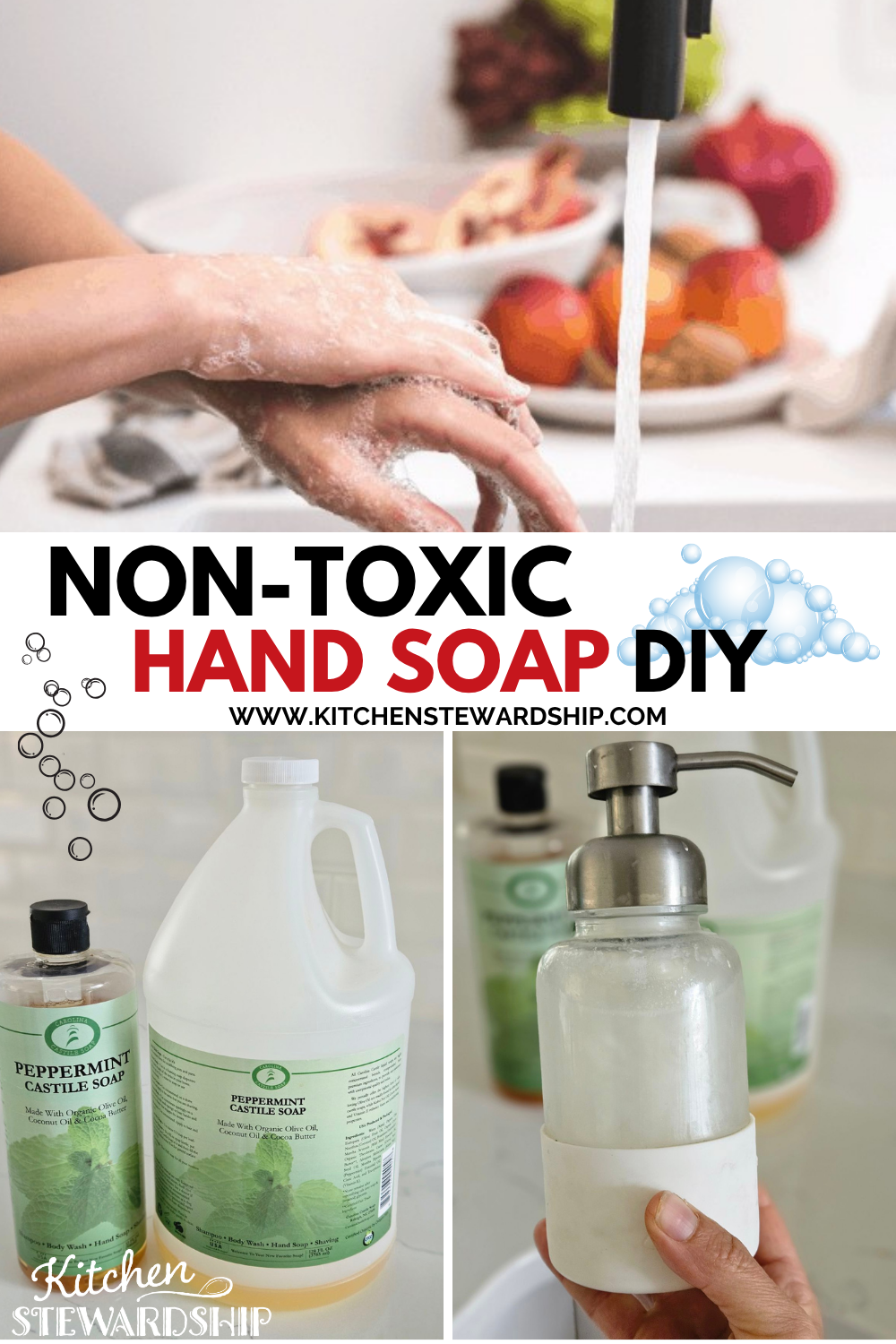
A reader recently emailed in asking what I use for nontoxic hand soap these days, and I knew I needed this update. Nostalgia hit hard!
Would you believe my very first post that I put out into the world at Kitchen Stewardship® in 2009 was about soap?
I came out of the closet as a true soap geek!

From Petri Dishes to Parenthood: My Soap Journey
In college, I did some really gross experiments using Petri dishes growing germs from community bathrooms to determine whether antibacterial soap was any better than regular hand soap or bar soap.
My conclusion, as a very rookie scientist seeking an English and education degree, was that soap and water does its job without any extra help.
The most disgusting Petri dish? Antibacterial hand sanitizer. That led me down a path of doing research into antibacterial products, and I stood on my literal soapbox any chance I could get, telling people that antibacterial soaps do more harm than good.
I’m tickled and justified that the world has finally caught up to what I learned way back then (sort of).
We’ve got the two extremes, where antibacterial products are ubiquitous, from cutting boards to rubber duckies to steering wheels; but on the other hand, we are seeing a push against the antibacterial soaps and sanitizers.

Why We Ditched Antibacterial Soaps (and What We Use Instead)
I’ve always tried to use clean ingredients to clean my house (pun intended?) since my babies were babies. If you are curious, as this reader was, about what we use for hand soap nowadays, we have two choices going on.
- Slightly more expensive but easier, and feels more like normal soap: Truly Free concentrate.
- A diluted castile soap.
Option 1: Truly Free Hand Soap That Feels Like the Real Thing
Here’s how #1 works. You get on a subscription with Truly Free, where you get my favorite laundry detergent, fabrict softener, and dishwasher detergent–and recently, everyday cleaners! Grab all the discounts you possibly can. (You can also get it on Amazon if you prefer.)
Truly Free has TWO deals that are so good I have to call them both out right now!
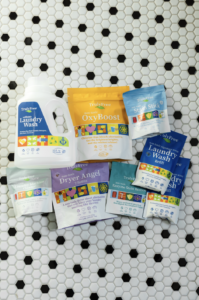
The Mixed Laundry bundle includes all of my favorite products: the laundry wash, oxygen bleach, stain remover and stick, a washing machine cleaner, and even the dryer angels to make your laundry smell amazing!
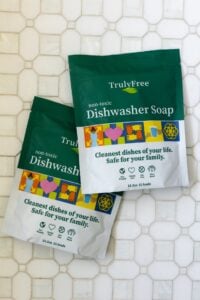
And for the kitchen, they have a test drive on the dishwasher detergent for just $5 – or you can get 100 loads free when you try out all their dishwashing products.
You can use any reusable foaming soap container, but Truly Free will also send you one with a convenient fill line for those members of the family who “conveniently forget” how to mix up the Castile soap version.
In your subscription, you’ll get a little packet of liquid, which you then mix with water. You’re saving a ton of fuel from being thrown into the air shipping water around the country! And of course, the ingredients are non-toxic, so no classic poison control center Mr. Yuk stickers needed.
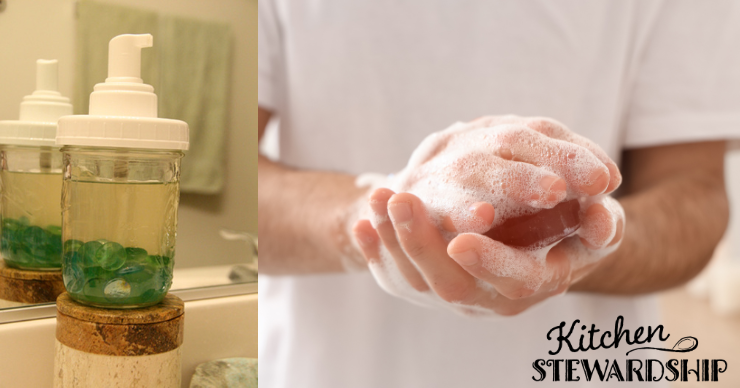
Option 2: Budget-Friendly DIY with Castile Soap
Here’s how #2 works.
- Grab some Castile soap from anywhere (I’ll tell you my most economical option in a second).
- Fill any reusable foaming soap dispenser, including those from Bath and Body Works that had the antibacterial stuff that you won’t buy anymore in it, and fill about three quarters of the way with tap water.
- Put in two or three hearty squirts of Castile soap.
- Cover the bottle with your palm and shake to combine, then use as you please.
Sometimes the Castile soap version creates a bit of a film on your sink and might not have the same feel as people are used to–so in a guest bathroom, you may want to opt for Truly Free.
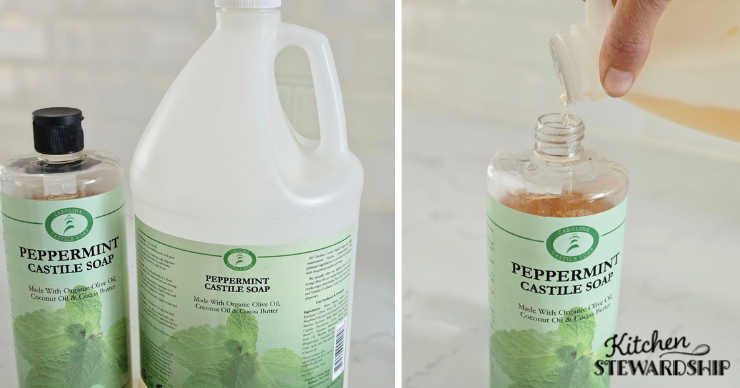
My system is to have a smaller bottle of Castile soap under each sink, so I don’t have to lug the gallon bottle around. Then I just refill those from the jug as needed, which isn’t very often!
You can see how I taught my kids to mix up this version of “homemade hand soap” on Instagram here.
Where I Buy Castile Soap in Bulk (and How Long It Lasts)
About two years ago, I realized that Country Life, where I buy a ton of bulk food, had a full gallon of Castile soap. I bought a quart to make sure I liked the brand, and it passed all of my happiness tests.
So now I can get away with buying one gallon every 18-24 months or so (I’ve just bought my second one), and that covers our entire household for hand soap.
Feel like a lot to spend on soap? I’m guessing my family goes through 1-2 bottles of soap per bathroom per month. Are they $5 apiece nowadays? I haven’t bought a single bottle of soap for years, but let’s say they are. If you have just two bathrooms and a kitchen, that’s $5-10 times 3 areas times 12 months in a year = $180-$360/year on hand soap. This one will last 1.5-2x that. What a deal!!!
You can get 5% off your first purchase at Country Life with the discount KATIE or by using this special link. Let me know if you have any questions about other items you see in bulk there!
Cleaning supplies are the one place you can afford—and even save money on—non-toxic options!!
Have your cake and eat it too with these simple tips from a mom with 20 years in the trenches of keeping her family safe (and mostly clean).
I created this when a young woman in need asked for bathroom cleaning supplies as a Christmas gift. 💔 My teacher heart wanted to teach her to fish, not just give her a fish.
Download it now in both a pretty version to look at and a black-and-white version to print:
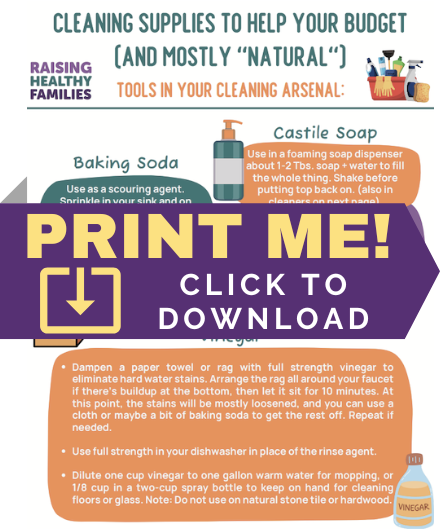
As a guest of Kitchen Stewardship, we’re pleased to give you this PDF. No need to trade your email address! We got you!
The Lowdown on Hand Washing
As many of us head back to school and into so-called flu season, we definitely want to teach our kids how hand washing works!
That first soap geek post was actually a three-part series that includes the science of how soap, water, and rubbing are the three-part hat trick to successful hand washing. No antibacterial products needed! We’ve compressed it all into one post now at The Dangers of Antibacterial Soap.


Great response! Thank you for taking the time!
Where does a normal bar of soap land compared to liquid soaps? I know it’s not a favorite for a guest bathroom but why not for the other ones?
Great question, Starlene! I feel pretty certain that even high quality soap, which could cost $6-10/bar, would be less “per handwash” than liquid. I guess that’s the “unit price” of soap, right, “per handwash?” 😀 It would be sooooo tough to compare IMO, because how many handwashes are in each bar/each bottle? My gut says the bar lasts a really really long time, because we do actually have bar soap in each bathroom (although not in the kitchen). The kids lean toward the foamy soap, but I want that bar there for when the bottle runs out and they don’t tell me and “forget” that they’ve learned how to refill it already LOL! There would also be some flex in “how long it would last” if you’ve got people who drown their soap and leave it sitting in puddles, for ex, because that makes it disappear faster.
Bottom line: I think your hunch is probably correct that the least expensive soap is a bar of soap. For certain purposes, esp the kitchen, we do like to have a pump, so I’ll always need some liquid or foaming soap as well.
Thanks for asking! This totally improves the post!
🙂 Katie
Thanks for such a detailed reply. Excellent point about how soap gets all smooshy and wasted when left in a puddle.
I should have worded my question better though because I was actually trying to ask about the efficacy of bar soap compared to antibacterial and non-antibacterial liquid soaps. But I’m thinking it probably has a lot to do with the individual handwasher vs the actual soap when it comes to bar vs liquid. It’s probably worth the extra money when you know the handwasher(s) are likely to rush and not do a thorough job. On the other hand, I kind of feel like bar soap forces you to rub your hands more. Anyways, you may not have an answer to my question. I was just curious if you tested the effectiveness of bar soap.
Ohhhhhh, as far as how well it cleans!! I did test liquid and bar way back in college when I did my experiment, and bar was right in there. Hand washing is a triple threat: soap, water, and rubbing. Not enough water? Soap won’t work. (Its only job is to increase the effectiveness of water at removing unwanted stuff.) No rubbing? The unwanted stuff might not get dislodged. Washing hands with water and vigorous rubbing is more effective than you might think! It’s not about killing germs really, just getting them to go somewhere other than your hands. 🙂 So in that case, all soap is equally effective WHEN used correctly, long enough, etc. You may have a point that if bar soap encourage more friction or longer under the water to get the soap off your hands, it would win every time. My experiment was controlled with 30 seconds of handwashing every time. It would be super interesting to observe REAL human behavior to see if different soaps encourage better handwashing. Foamy soap is probably the worst! Because it could just rinse off too quickly. 🙁 Great question!
: ) Katie